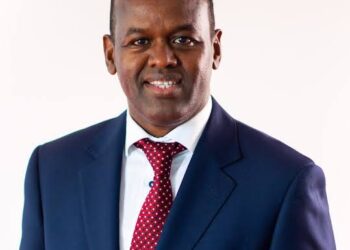
The appointment of former Absa Bank Kenya CEO Abdi Mohamed as the new Chief Executive Officer of I&M Bank is not just another boardroom change. It points to a bigger shift in Kenya’s banking sector, where lenders are racing to win affluent clients, deepen private banking, and build stronger regional platforms across East Africa.
I&M Group announced Mohamed’s appointment subject to approval by the Central Bank of Kenya. His move comes at a time when competition in the banking sector is shifting beyond traditional lending into wealth management, personal banking, investment advisory, trade finance and regional client relationships.
For I&M, the appointment could be a strategic play for the next phase of growth. The bank already has operations in Kenya, Tanzania, Rwanda, Uganda and Mauritius, giving it a regional platform that can serve businesses, entrepreneurs and high-net-worth individuals with interests across borders.
This regional footprint matters because banks are increasingly following wealth, trade and investment flows across East Africa. Kenya remains a key financial hub in the region, while Nairobi continues to attract entrepreneurs, investors, family businesses and professionals looking for more sophisticated financial services.
According to the Africa Wealth Report 2025 by Henley & Partners and New World Wealth, Kenya is one of Africa’s top five wealth markets, with about 6,800 dollar millionaires. Nairobi alone has about 4,200 millionaires, making it one of Africa’s leading wealth hubs.
This is the market banks are now fighting for.
Affluent clients no longer want basic banking services alone. They are looking for investment products, wealth planning, offshore access, foreign currency solutions, insurance, succession planning, estate planning, and seamless banking across different markets. For banks, this is attractive because it opens up growth in non-interest income at a time when margins from lending remain under pressure.
I&M’s own numbers show why this direction is important. In its FY2025 highlights, the group reported KSh60.3 billion in total revenue, KSh668.9 billion in total assets, KSh484 billion in customer deposits and KSh14.4 billion in non-interest income. In Q1 2026, reports showed that its wealth management revenue more than tripled, signalling growing traction beyond traditional lending.
Mohamed’s experience may therefore be important for I&M. At Absa, he was exposed to retail banking, business banking, digital transformation, operations and regional leadership. Those are the same capabilities I&M will need if it wants to become more aggressive in personal, private and business banking.
The move also comes as larger banks sharpen their East Africa strategies. Nedbank has made a move to acquire a majority stake in NCBA Group, while Standard Bank has strengthened its regional leadership structure for East Africa. Absa Group has also appointed former M-Pesa Africa boss Sitoyo Lopokoiyit to lead personal and private banking across the continent.
This shows that the battle for East Africa is not only about branch networks or corporate lending. It is increasingly about who owns the customer relationship, especially among entrepreneurs, wealthy families, professionals, diaspora-linked clients and regional businesses.
For I&M, Abdi Mohamed’s appointment could help the lender move from being seen as a strong mid-tier bank to a more serious challenger in the region’s affluent banking space. The real test will be whether the bank can turn its regional footprint, wealth management products and customer relationships into a stronger private banking proposition.
In that sense, the move is less about one CEO changing banks and more about where the banking sector is headed. East Africa’s next banking battle will be fought around wealth, mobility, investment and relationships. I&M appears to be positioning itself for that fight.