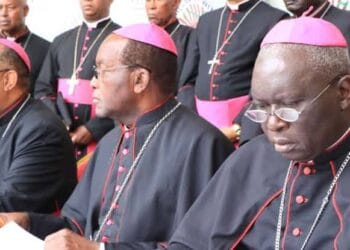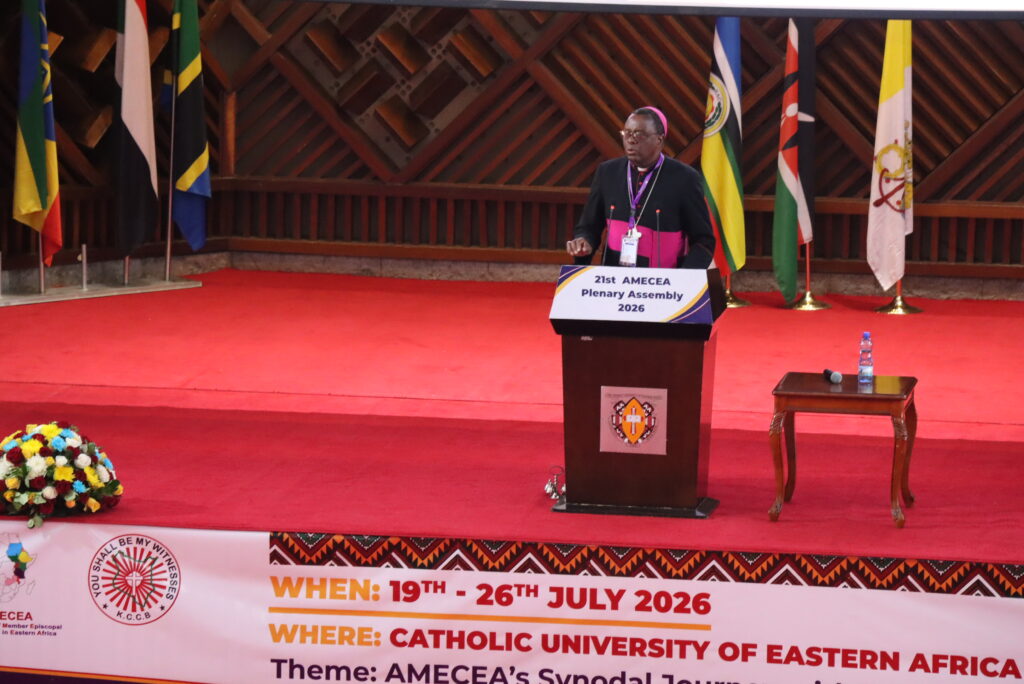
More than 100 Catholic bishops and delegates from across Eastern Africa have gathered in Nairobi for the 21st Plenary Assembly of the Association of Member Episcopal Conferences in Eastern Africa, known as AMECEA.
Hosted by the Kenya Conference of Catholic Bishops at the Catholic University of Eastern Africa, the assembly runs from July 18 to 26, 2026. It is being held under the theme, “AMECEA’s Synodal Journey with Young People: Building Bridges of Communion, Hope, Justice and Good Governance.”
The meeting has placed young people at the centre of discussions about the future of the Church and the wider Eastern African region, amid concerns over unemployment, conflict, corruption, political exclusion, poverty and limited access to economic opportunities.
What is AMECEA?
AMECEA is a regional pastoral organisation that brings together Catholic bishops’ conferences from Eritrea, Ethiopia, Kenya, Malawi, South Sudan, Sudan, Tanzania, Uganda and Zambia. Djibouti and Somalia participate as affiliate members.
The organisation promotes cooperation among Catholic bishops and enables the Church to develop common responses to pastoral and social issues affecting countries across Eastern Africa.
Its plenary assembly, held in ordinary session every four years, is AMECEA’s highest decision-making forum. It allows bishops and other Church representatives to pray, assess their shared mission and agree on priorities that will guide the regional Church in the years ahead.
The 2026 gathering is therefore more than a conference. Its discussions and resolutions are expected to shape pastoral programmes, youth engagement and the Church’s advocacy on justice, peace and governance across the region over the next four years.
Why AMECEA 2026 matters
The assembly comes at a time when Eastern Africa’s youthful population is confronting widespread unemployment, political frustration, violent conflict, forced displacement and declining trust in institutions.
By choosing young people as its main pastoral priority, the Church is acknowledging that the region’s youth should not simply be discussed as future leaders. They must be listened to and actively involved in decisions affecting the Church and society today.
AMECEA Chairman and Bishop of Solwezi in Zambia, Most Rev. Charles Kasonde, announced that youth ministry would be the Church’s leading pastoral priority for the next four years.
“Your Bishops make young people our pastoral priority for the next four years,” Bishop Kasonde said, explaining that the Church wanted to demonstrate that young people were worth its investment and help them develop a stronger sense of belonging.
Earlier, Bishop Kasonde described the plenary as an opportunity for the Church to listen and discern how it could serve communities more effectively.
“It is also a moment to respond to the aspirations of our people, especially the young, who are calling for justice, accountability, and hope,” he said.
This focus makes the assembly relevant beyond Catholic structures. Its agenda touches on issues affecting governments, communities and families throughout the region, including ethical leadership, peaceful political participation, employment and the inclusion of young people in decision-making.
Church called to listen to young people
One of the strongest messages emerging from the Nairobi gathering has been the need for Church leaders to listen more carefully to young people.
Archbishop Menghesteab Tesfamariam of the Catholic Archdiocese of Asmara in Eritrea said genuine synodality required leaders to give young people time and attention.
“Synodality is asking us to stop talking and start listening,” Archbishop Tesfamariam said.
“If we want to be ministers of hope to our young people, we need to listen to them attentively and actively and give them all the time they need.”
He identified unemployment, poverty, corruption, a lack of business capital and the mismatch between education and available jobs as some of the main challenges confronting young people in the region.
His remarks reflect the wider meaning of synodality, which calls on the Church to journey together through listening, dialogue and shared participation rather than relying only on decisions made from the top.
Cardinal Czerny urges youth not to lose hope
Cardinal Michael Czerny, Prefect of the Vatican’s Dicastery for Promoting Integral Human Development, challenged young people not to surrender to discouragement despite the crises facing their societies.
“Do not let yourselves be robbed of hope,” Cardinal Czerny told young people during the opening Eucharistic celebration.
He encouraged Christians to become builders of authentic bridges of communion and peace, arguing that faith should move people beyond merely condemning injustice towards actively transforming society.
In his address to the assembly, Cardinal Czerny described the gathering as a shared vocation to bring the Gospel’s message of justice, love and peace into every part of society.
His message positioned hope not as passive optimism, but as a call for patient, collective action in response to suffering, exclusion and injustice.
Kenyan bishops describe gathering as a moment of grace
For the Catholic Church in Kenya, hosting the regional assembly is also a significant moment of recognition and responsibility.
Archbishop Maurice Muhatia Makumba, Chairman of the Kenya Conference of Catholic Bishops, described the plenary as “a moment of grace” for Kenya and the wider Eastern African region.
“We are honoured as a country and as a local Church to host this plenary assembly,” Archbishop Muhatia said.
“It brings together the People of God from across our region to reflect on our shared pastoral realities and to strengthen our common mission of evangelization.”
He also emphasised that young people should not be viewed only as the Church’s future.
“The young people are not only the future of the Church; they are its present,” he said.
The statement captures one of the central messages of AMECEA 2026: meaningful youth inclusion must happen now rather than being postponed to an undefined future.
Mudavadi calls for peaceful change
Prime Cabinet Secretary Musalia Mudavadi, who represented President William Ruto during the official opening, called for cooperation between governments, religious leaders and young people in promoting peace, empowerment and good governance.
Addressing young people seeking political and social change, Mudavadi urged them to remain disciplined and reject violence.
“Let us reform. Let us change. Let us build our nations. Let us bring peace. But let us avoid bloodshed,” he said.
His remarks highlighted the delicate environment in which the assembly is taking place, as young people across the region increasingly demand accountability, economic opportunity and greater participation in governance.
Beyond the Nairobi meeting
The success of AMECEA 2026 will ultimately depend on whether its resolutions are translated into practical programmes at diocesan, parish and community levels.
Declaring young people a pastoral priority is an important step, but the commitment will require stronger youth representation, mentorship, skills development, employment initiatives and platforms through which young people can influence both Church and public affairs.
It will also require the Church to use its extensive network of schools, universities, hospitals, parishes and development organisations to address the realities facing young people.
The plenary’s lasting significance may therefore be measured not only by the speeches delivered in Nairobi, but by whether young people across Eastern Africa feel heard, supported and empowered after the delegates return home.
For a region searching for peace, accountable leadership and renewed hope, AMECEA 2026 presents the Catholic Church with an opportunity to demonstrate that listening to young people can lead to meaningful and lasting action.