
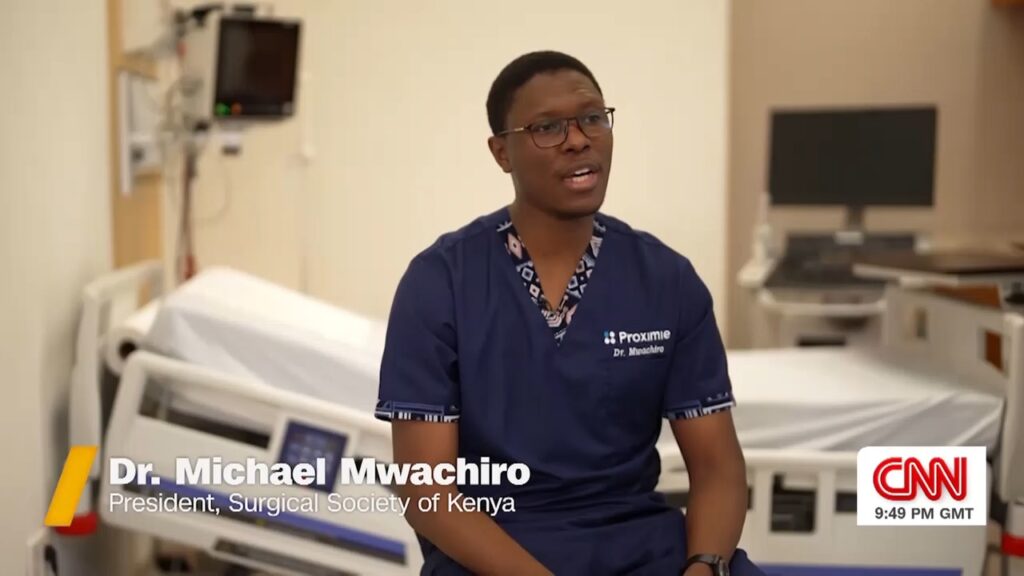
A recent episode of CNN International’s Marketplace Africa spotlighted how medical teams in East Africa are using technology to improve surgical training, support specialists, and expand access to healthcare expertise across the continent.
The programme featured two initiatives using digital tools to address one of Africa’s urgent healthcare challenges: the shortage of surgeons and specialist medical professionals.
Across East Africa, some operating rooms are now being fitted with cameras connected to platforms that allow surgeons, trainees, and medical educators to participate in live procedures remotely. One such platform, Proximie, enables surgeons in different parts of the world to collaborate during operations and training sessions.
Speaking to CNN, Dr. Michael Mwachiro, President of the Surgical Society of Kenya, said the platform “allows a surgeon to participate in an actual live case that is going on somewhere in the world,” with users currently connected across regions including the UK, the US, Asia, and Africa.
Healthcare professionals say the technology is helping reduce the time and cost associated with surgical training, particularly in contexts where trainees may otherwise need to travel long distances to observe procedures.
Dr. Desire Rubanguka, a surgeon at King Faisal Hospital, told CNN that remote surgical participation can help hospitals save time and resources while improving service delivery. He gave the example of trainees who would otherwise need to travel several hours to attend training physically, saying that virtual connection allows them to learn without losing an entire day to travel.
The Proximie platform also allows medical images and live video to be annotated in real time, helping trainees follow procedures more closely. David Cuyubahiro, Chief Resident at King Faisal Hospital, said the technology gives learners an interactive experience, allowing them to ask questions and observe key anatomical structures as they are highlighted during surgery.
Another initiative featured in the programme is IRCAD Africa, where a team in Rwanda is developing scalable and cost-effective medical tools for wider use in healthcare settings.
One of the projects highlighted is a portable ultrasound solution designed to make imaging more accessible, even in facilities without highly specialised radiology staff. Yvonne Keeza, Head of Research and Development at IRCAD Africa, told CNN that the tool is being developed so that users can scan the liver and generate a three-dimensional image using an AI model.
Keeza said the technology could support both diagnosis and treatment, including procedures such as thermal ablation, where heat or freezing is used to target cancer cells. She said the goal is to help clinics move from diagnosis to treatment within the shortest possible time.
According to Keeza, the innovation depends on close collaboration between engineers and medical professionals. She said the team works to ensure that AI models perform with high accuracy before being deployed in clinical settings.
The stories were featured on the latest episode of Marketplace Africa on CNN International.