Kenya’s grain milling industry, which feeds more than 40 million people every day and controls over 95 percent of the country’s wheat milling capacity, is facing a deepening structural crisis at the intersection of public health, economic pressure, and weak regulation.
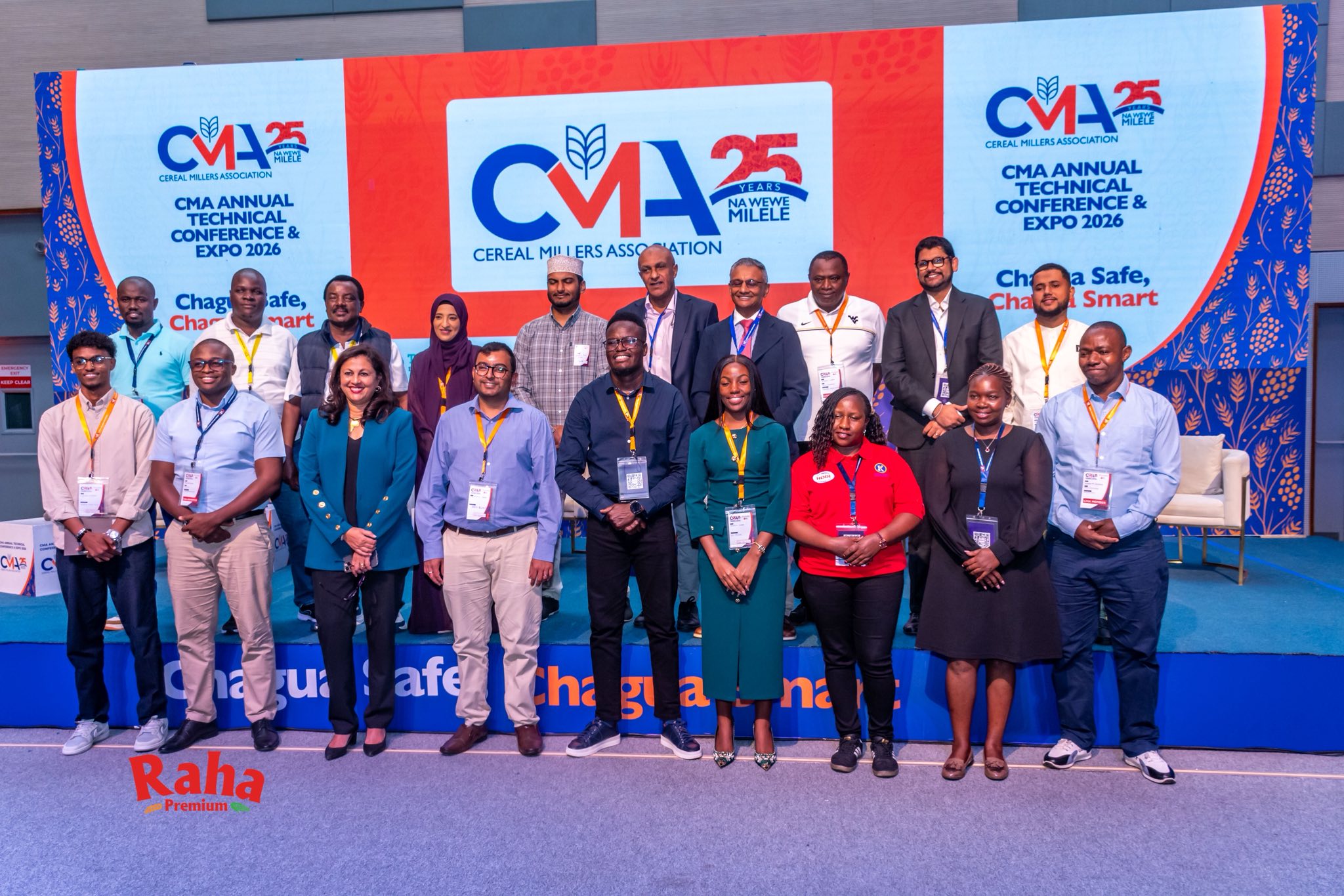
Speaking at the Cereal Millers Association (CMA) Annual Technical Conference and Expo 2026 in Nairobi on Tuesday, industry leaders said the cost of compliance is becoming a burden in a market that often punishes millers for doing the right thing. Held under the theme Chagua Safe, Chagua Smart, the conference highlighted how responsible producers are struggling to compete against cheaper, non-compliant products.
The imbalance is glaring. A two-kilogramme packet of compliant, fortified flour sells for about KSh 160, while a non-compliant alternative retails at roughly KSh 80. For millers who invest in certified premix, calibrated dosing systems, quality control teams, and aflatoxin testing, that gap is less a market difference than a financial penalty.
Aflatoxin remains one of the industry’s gravest concerns. Produced by fungi that thrive in poorly stored grain, the toxin is invisible, tasteless, and survives the milling process. Once contaminated grain enters the food chain, the toxin cannot be removed. Across Africa, an estimated 40 percent of grain supply is affected each season.
In Kenya, aflatoxin has been linked to liver cancer, stunted growth in children, and weakened immunity. For millers, the costs are equally harsh. During peak contamination periods, some operators say they are forced to reject as much as 25 percent of incoming grain, absorbing the losses with no clear path to recovery.
“They enter the food chain silently, and once present, they cannot be removed,” said Ms Suad Abubaker, CMA Board Member and Director of Pembe Flour Mills, in remarks that set the tone for the conference.
The event brought together millers, regulators, development finance institutions, and technology providers, and underscored a reality the sector has long understood but rarely stated so bluntly: compliance does not pay, at least not in the short term, and not without a market that rewards it.
Panelists from Bidco, Pembe Flour Mills, Sanku, and Bakels detailed the true cost of responsible milling. These include micro-feeder calibration, premix procurement, staff training, and laboratory verification. They noted that even hidden costs such as overdosing or under-dosing can quietly erode profit margins while also affecting nutrition outcomes and regulatory compliance.
Flour fortification is a legal requirement under Kenya’s food standards framework. It adds iron, zinc, folic acid, and vitamins A and B to staple flour, helping improve child growth, reduce anaemia, and strengthen immunity.
Even so, compliance remains expensive. The cost of premix, dosing equipment, and skilled oversight places formal millers at a disadvantage compared with the thousands of informal posho mills, or kisiagis, that operate outside the fortification system.
“Rubbish in, rubbish out. Whatever you supply to the miller, the miller churns out almost ten times that,” said Ms Felistus Mutambi of Sanku, pointing to poor-quality premix and upstream failures that are magnified at scale.
Some solutions are beginning to show results. According to Elizabeth Cushny of TechnoServe, the Kenya Millers Fortification Index, a recognition programme designed to make compliance visible to buyers and consumers, has helped participating millers boost sales by up to 50 percent within six months. The finding suggests that when consumers can clearly identify compliant products, trust can become a real commercial advantage. It also points to a broader policy lesson: where the market does not naturally reward compliance, structured visibility can help close the gap.
Still, the informal milling sector remains the hardest challenge. Small-scale posho mills, which supply a significant share of maize flour to lower-income households, operate largely outside the fortification regime. Pilot efforts involving the World Food Programme and partners such as Sanku are testing whether fortification technology can be extended to these mills, but scaling the model will be difficult without stronger government support.
Technology may offer part of the answer. At the conference, participants were introduced to Aflabox, a portable AI-powered grain scanner that can detect aflatoxin in under 90 seconds with about 97 percent accuracy, without the need for reagents or laboratory infrastructure. Priced at around USD 5,000, the device could help decentralise quality control from the farm gate to mill intake. Its cloud-based analytics also make it possible to build regional contamination maps, giving regulators and development partners a better tool for prevention.
Regulators were also challenged to improve oversight by moving away from manual, occasional inspections and toward integrated data systems linking licensing, taxation, certification, and field surveillance across KEBS, KRA, and county governments.
Panelists further called for public procurement policies that prioritise compliant millers supplying schools, hospitals, and other state institutions. Such demand-side interventions, they argued, could reshape market incentives without waiting for new legislation.
The CMA, which represents more than 60 members and accounts for about 40 percent of Kenya’s maize milling capacity, said the conference is meant not just for sector dialogue but for accountability. By framing compliance as a public good that lowers cancer risk, improves child nutrition, and protects consumer confidence, the association signalled that the industry’s economic future cannot be separated from its public health responsibilities.
The conference continues on Wednesday with a strategic leadership forum focused on consumer trust, demand creation, and the future of Kenya’s retail food market.