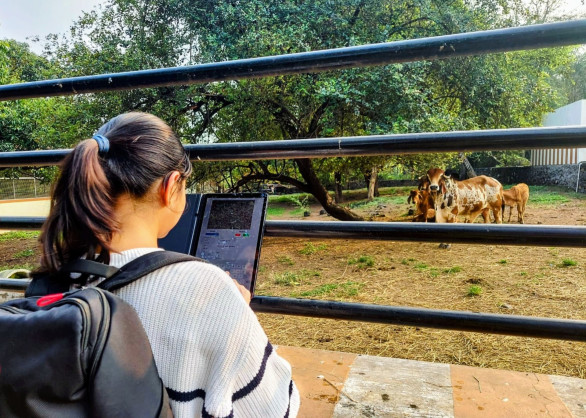
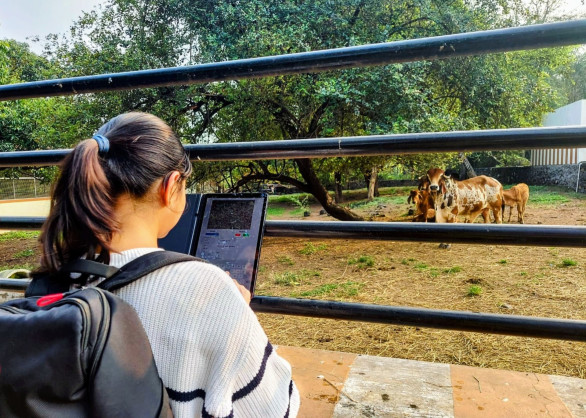
A dirt road in Kenya. Heavy heat shimmers over the surrounding savannah. A loan officer approaches a herd of cattle and pulls out a smartphone. Standing next to the owner, a woman with a proud yet cautious gaze, he photographs an animal. Hundreds of miles away, an artificial intelligence algorithm transforms that animal into a bankable asset.


This scene illustrates the quiet revolution led by Jenny Ambukiyenyi Onya. A young Congolese engineer, she is tackling a paradox that traps millions of women living in rural areas in precarious conditions. The challenge is staggering. Sub-Saharan Africa has around 200 million smallholder farmers, a significant proportion of whom raise livestock. Women account for up to 60 percent of these farmers, representing an economic force of 80-120 million rural female livestock keepers.
Yet, this force remains virtually invisible to the financial system. Studies conducted by the Food and Agriculture Organization of the United Nations (FAO) show that women receive only 10 percent of smallholder-targeted loans and barely 1 percent of all agricultural loans. The result? An estimated between 70-115 million women are effectively excluded from formal financing.
Their livestock is their savings account. But without a reliable way to document their herds, how can they prove ownership of 10 cows? Traditional methods, such as ear tags, are fragile and easy to falsify, making verification by a banker nearly impossible and turning a woman’s most valuable asset into an invalid guarantee.
“It was by combining these two realities – a need for reliability in the field and in-house technical expertise – that the idea emerged: why not apply AI to recognizing assets such as livestock?” explains Jenny.
Her solution, Halisi Livestock, works like facial recognition for animals. “A loan officer can take a photo of a cow’s face using a simple smartphone,” she explains. “Using biometric recognition algorithms, our AI analyses each animal’s unique features and generates a digital identity that cannot be falsified.”
This innovation is the key to unlocking financing. First, the digital identity provides farmers with a reliable, indisputable way to count and value their herds. Next, the digital inventory serves as irrefutable proof of ownership, transforming a moving asset into a verifiable guarantee. Finally, this collateral, which can be verified remotely, gives financial institutions the confidence to approve loans.
“For a financial institution, it is no longer a rough estimate, but concrete and reliable data. We are no longer talking about an ‘informal’ profile, but a digital asset that is registered, verified, and integrated into a structured portfolio,” summarizes Jenny. Trust, built on data, finally opens the doors to credit.
The transition from promising innovation to large-scale solution was achieved thanks to the “Enhancing Women Entrepreneurship for Africa” programme, supported by Affirmative Finance Action for Women in Africa (AFAWA) (https://apo-opa.co/4nKHta9), the African Development Bank’s initiative for financing women in Africa. “Joining the programme marked a turning point in our journey,” Jenny acknowledges. “The support provided allowed us to benefit from strategic guidance to strengthen our vision and above all, to refine our product in order to achieve a better fit between the product and the market.” Thanks to this support, the company she founded, Neotex.ai, has rolled out its services in new rural areas in Kenya, registering more than 1,250 head of livestock and proving the viability of its model.
Beyond facilitating access to loans, Jenny Ambukiyenyi Onya’s vision is to redefine the role of rural economies in Africa. She believes technology makes the livestock sector “visible, measurable and able to be modelled” for investors and policymakers.
Her message is twofold. She calls on financial institutions to invest “in high-potential local economies, often led by women.” To young African women dreaming of innovating, she offers her own journey as proof. “Dare to create. Even in sectors where you are not expected to. If I can build disruptive solutions from a cell phone and a herd of cows, you too can reinvent what no one has yet dared to imagine.”
Distributed by APO Group on behalf of African Development Bank Group (AfDB).
Editor’s note:
15 July 2025 marks the 10th anniversary of the United Nations World Youth Skills Day. This year’s theme focuses on empowering young people through artificial intelligence and digital skills.
About the African Development Bank Group:
The African Development Bank Group is Africa’s premier development finance institution. It comprises three distinct entities: the African Development Bank (AfDB), the African Development Fund (ADF) and the Nigeria Trust Fund (NTF). On the ground in 41 African countries with an external office in Japan, the Bank contributes to the economic development and the social progress of its 54 regional member states. For more information: www.AfDB.org