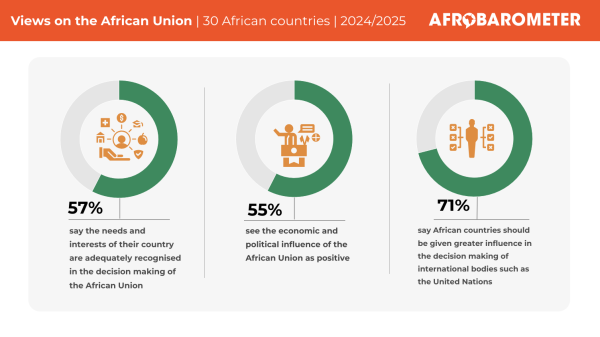

Seven in 10 Africans support the idea that African countries should be given greater influence in the decision making of international bodies such as the United Nations, the latest Afrobarometer (www.Afrobarometer.org) survey findings reveal.
Data from 30 African countries show that a majority of Africans think the needs and interests of their country are adequately recognised in the decisions of the African Union (AU) and of their regional economic organisation (e.g. the Southern African Development Community, Economic Community of West African States, East African Community, and Arab Maghreb Union). A majority see the economic and political influence of the AU on their country as positive.
Positive perceptions of the economic and political influence of China, African regional organisations, the United States, the European Union, former colonial powers, India, and Russia also outweigh negative perceptions, although large proportions of Africans don’t take a stand on this question.
Key findings
- On average across 30 African countries, seven in 10 citizens (71%) say African countries should be given greater influence in the decision-making of international bodies such as the United Nations (Figure 1). Majorities “strongly” endorse this view in Tunisia (57%) and Senegal (54%).
- Majorities say the needs and interests of their country are adequately recognised in the decision making of the African Union (57%) and of their regional economic community such as the Southern African Development Community, Economic Community of West African States, East African Community, and Arab Maghreb Union (Figure 2).
- More than half (55%) of Africans see the economic and political influence of the African Union as positive, including large majorities in the Gambia (66%), Côte d’Ivoire (68%), Mauritania (69%), and Liberia (79%) (Figure 3). Only 14% see its influence as negative, though critics are much more common in Mali (34%), Congo-Brazzaville (30%), and Guinea (30%).
- Six in 10 Africans see China’s economic and political influence on their countries as positive (60%), exceeding positive perceptions of the influence of their regional organisation (57%), the United States (53%), the European Union (49%), their former colonial power (41%), India (38%), and Russia (36%) (Figure 4).
- But large proportions of Africans see neither positive nor negative influence or say they “don’t know” or refused to answer the question, ranging from 21% on China to 42% on India.
Afrobarometer surveys
Afrobarometer is a pan-African, non-partisan survey research network that provides reliable data on African experiences and evaluations of democracy, governance, and quality of life. Nine survey rounds in up to 42 countries have been completed since 1999. Round 10 surveys were launched in January 2024.
Afrobarometer’s national partners conduct face-to-face interviews in the language of the respondent’s choice that yield country-level results with margins of error of +/-2 to +/-3 percentage points at a 95% confidence level.
Distributed by APO Group on behalf of Afrobarometer.
For more information, please contact:
Asafika Mpako
Communications coordinator for Southern Africa
Email: ampako@afrobarometer.org
Telephone: +27 83 979 8299
Social Media:
Facebook
X
LinkedIn
YouTube
Instagram
WhatsApp
Bluesky
Visit us online at www.Afrobarometer.org.
Follow our releases on #VoicesAfrica.