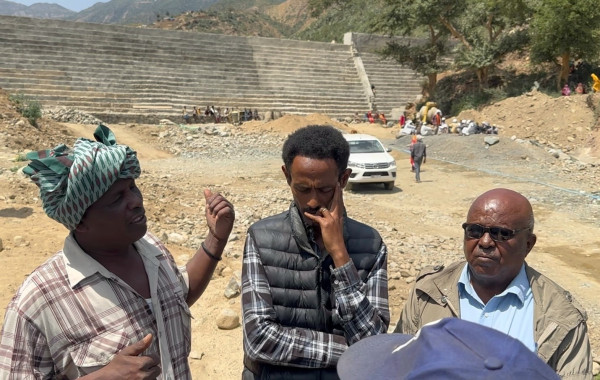

In villages across Eritrea’s dry interior, change is quietly flowing. Where seasonal rivers once surged and vanished without trace, hand-built dams now hold back precious water. Irrigation canals feed crops even in dry months.
Also Read

Eritrea, one of the Horn of Africa’s most drought-prone countries, has adopted a straightforward approach to tackling water scarcity: building dams—many of them small, masonry structures—using local materials and community labour.
Backed by technical assistance and concessional funding from the African Development Bank, the country has constructed or rehabilitated over 880 dams, most in rural and underserved areas. As a result, communities long dependent on erratic rainfall are now looking to the future with renewed confidence and excitement.
Bekit Idris recalled a life marked by constant fears of food scarcity and malnutrition before a dam came near his home area of Guritatal, in central Eritrea. “Our crops depended on the rain,” Idris explained. “The rains had increasingly become erratic and unevenly distributed but following the project, I have cultivated land downstream of the dam.” He now grows cereal crops, vegetables, fruits, and green fodder for livestock feed.
“I am now harvesting three times a year, as opposed to only once a year before,” he said. “Before the dam was built, our food production was barely enough for our needs… Now I produce enough not only to feed my family, but also to sell in the market. This has greatly improved both our nutrition and household income.”
Since 2015, the African Development Bank has supported this effort through the Drought Resilience and Sustainable Livelihoods Programme, which aims to reduce vulnerability in the Horn of Africa. In Eritrea, the project financed the construction of 98 small and medium-sized dams and 11 related water points. It also rehabilitated over 200 hectares of degraded land.
Improved water availability is just one tangible result. Additionally, the project has lifted communities from subsistence farming to more sustainable and commercial agricultural practices, improving the state of food security and livelihoods across the country.
The DSLRP project targets the construction of over 116 masonry dams to support irrigated agriculture. The dams have capacity range from 30,000m³ to over 110,000m³, allowing local farmers in the targeted areas of central, southern, and northern Eritrea to produce substantial quantities of vegetables and cereals.
The project has also promoted new skills training and entrepreneurship promotion to stimulate overall value chain development. Further, the programme supplies farmers with different types of agricultural inputs that enable them to improve production and boost productivity per unit area.
Supported communities view the initiative as a step forward in Eritrea’s broader efforts to strengthen rural resilience, improve nutrition, and reduce poverty.
Hamed Meskel, a farmer benefitting from the Aderde dam in the northern region, was practising small-scale irrigation with a limited amount of water prior to the advent of the DSLRP project.
“Things were slowly getting worse as the wells in the area were drying,” he said. “I was forced to stop cultivating crops, but I have resumed. Because of the construction of this dam, water is now available.”
Meskel proudly boasted about his biannual harvests of vegetables, fruits and animal fodder, with an overall increase per unit area of about 30 percent. Meskel’s farm also serves as a demonstration plot for nearly 350 other farming households in the area.
Roughly 73 percent of Eritreans depend on agriculture and its allied fields for income and employment.
According to Kenneth Onyango, Chief Country Program Officer at the Bank’s Eritrea liaison office, “This project has immensely contributed to the expansion of agriculture and agribusiness opportunities in rural Eritrea as a means to advance rural livelihoods and economic development.”
The project, he said, is structured around community participation, which has allowed for achievements to be reached earlier than planned. “The communities are seeing results, and we see the livelihood changes evidenced by a wider adoption of agriculture as a source of income for many households in the targeted communities,” Onyango underscored.
The programme, in its fifth phase, is scheduled to run until December 2026.
On the ground, water has brought more than food. Communities are also growing a greater sense of security in a changing climate. Hope has also taken root.
“We are very happy with the initiative, which has been very instrumental in improving the livelihood of the community in line with the Ministry of Agriculture’s five-year strategic plan,” DRSLP Project Coordinator, Hadgu Gebrendrias said. He added that the construction of the 98 masonry dams, to date, has encouraged the construction of new soil and water conservation structures over 9,800 hectares upstream of the dams in all of Eritrea’s six regions over the last five years.
“This has significantly contributed to enhancing drought resilience, improving sustainable livelihoods, and promoting food and nutrition security—particularly among pastoral and agro-pastoral communities in Eritrea,” Gebrendrias noted.
Distributed by APO Group on behalf of African Development Bank Group (AfDB).