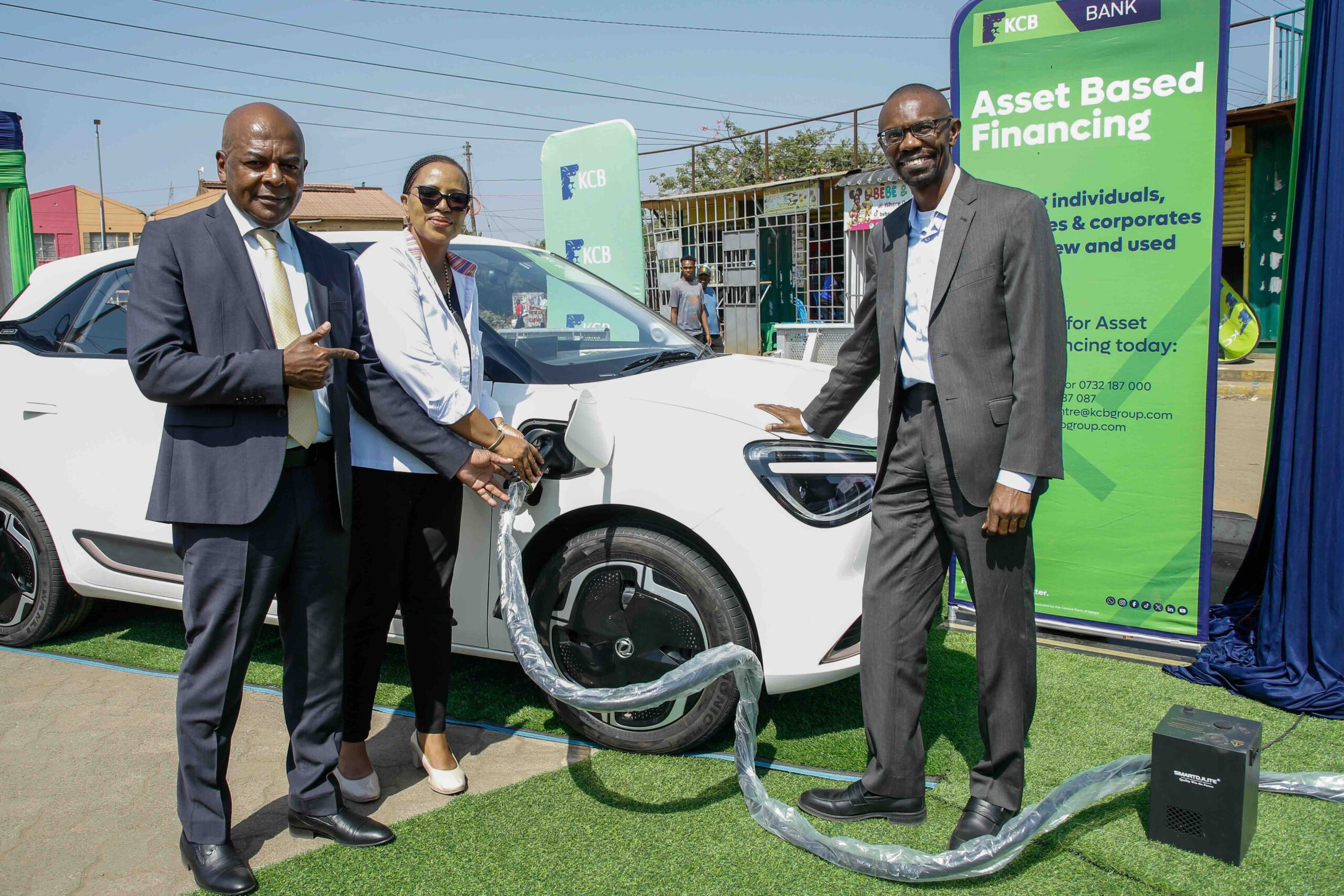
The transition to electric public transport has entered a new phase after KCB Bank Kenya, the Matatu Owners Association (MOA), and ePureMotion moved beyond policy commitments to on-the-ground implementation, with the launch of a public service vehicle (PSV) electric vehicle (EV) charging Station Site in Nairobi’s Buruburu Estate.
The rollout builds on the KCB Bank Kenya partnership announced in 2024, in which the lender committed to finance towards public transport modernisation, including access to asset finance and insurance premium finance for matatu saccos to upgrade their fleets.


The new EV charging Station Site demonstrates how financial institutions, industry coordination, and technology can be integrated to accelerate the modernisation of the matatu sector. The public transport sector plays a critical role in the country’s socio-economic growth, yet it remains a significant source of Greenhouse Gas Emissions (GHG) and air pollution.
ePureMotion, a leading electric vehicle company in Kenya, based Nairobi is helping turn the shift to electric public transport into reality by providing charging stations, maintenance, spare parts, training, and, in future, electric matatus and digital tools to help operators run their businesses efficiently.
Speaking during the launch, Juliana Kinyua-KCB Bank representative Ag. Unit Head, Asset Finance & Insurance Premium Finance said; the activation demonstrates the bank’s commitment to supporting entrepreneurs and investors in the public transport sector with financial solutions that can unlock the entire ecosystem of modern, efficient and sustainable mobility all over the country.
“KCB’s partnership with the Matatu Owners Association is about unlocking practical financing pathways that allow the public transport sector to modernise at scale. The launch of this PSV EV charging site in Buruburu demonstrates how financing, infrastructure and sector coordination with partners such as ePureMotion can come together to support cleaner, more efficient and more affordable mobility for Kenyans.”
KCB will support eligible public transport investors and saccos through structured financing solutions, subject to normal credit assessment, documentation and approval.
Matatu Owners Association (MOA) President Albert Karakacha said the initiative places matatu owners and saccos at the centre of the EV transition and creates a pathway for members to access financing, infrastructure, training, and commercial opportunities linked to the future of public transport.
“The matatu industry has always been the backbone of everyday mobility in Kenya. Through this collaboration with KCB and implementation support from ePureMotion, MOA is taking a deliberate step to ensure that our members are not left behind in the transition to electric mobility,” said Mr Karakacha.
MOA will coordinate and mobilise the matatu sector, identify participating saccos and operators, support member readiness and help ensure the transition creates value for the industry.
In February, the government launched the National Electric Mobility Policy, marking a milestone in Kenya’s journey towards a clean, efficient, and inclusive transport system. Through this policy, the government set out a clear framework for promoting the adoption of electric mobility technologies, building the necessary infrastructure, and fostering innovation and investment in the sector.
In Kenya, the public transport sector is almost entirely powered by fossil fuels, given that the sector utilises about 72 per cent of the petroleum products imported into the country.
The need to promote EV arises from the country’s commitment to various international agreements to reduce GHG emissions, such as the Paris Agreement; the burgeoning fuel importation costs; the grid availability, which is generated from well-diversified energy mix, with nearly 90 per cent of energy being generated from clean sources including geothermal, solar, hydro, and wind; as well as economic opportunities with electric mobility.
The Buruburu charging site will serve as an early demonstration and learning point for PSV EV operations, including charging, daily vehicle readiness checks, service scheduling and operator trainings. The partners expect the model to inform future sites selection country wide and rollout across other high-potential matatu routes and Sacco locations.