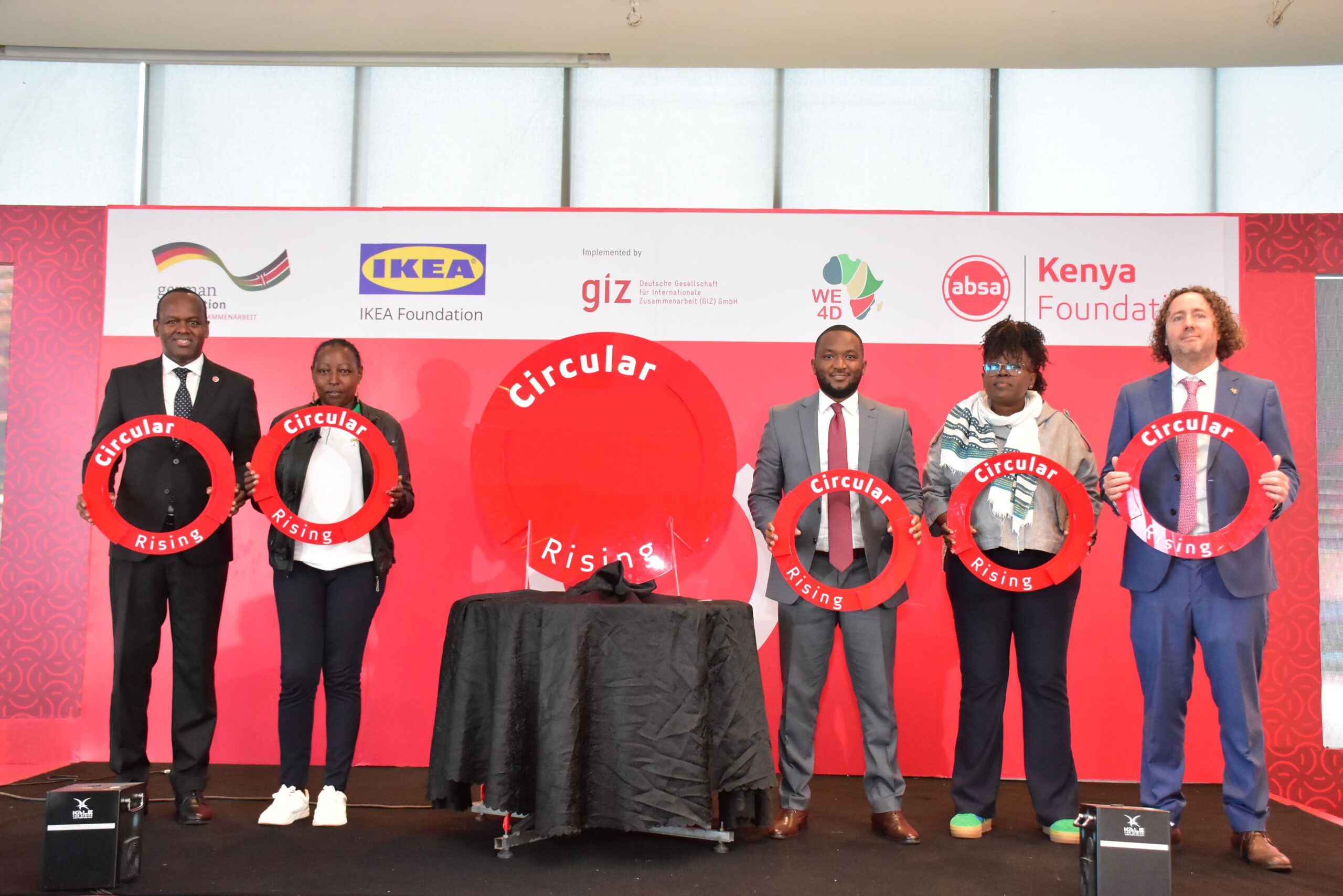
Absa Kenya Foundation has partnered with the German Corporation for International Cooperation (GIZ) and the African Guarantee Fund (AGF) to launch Kenya’s first large-scale CirculaRising Programme.
The initiative seeks to create over 6,000 new and improved jobs in the next two to three years while supporting more than 2,000 women- and youth-led micro, small and medium enterprises in Kenya’s circular economy.


The programme also targets recycling more than 6,000 tonnes of waste and indirectly impacting over 30,000 lives.
Speaking during the launch in Nairobi, Absa Bank Kenya Managing Director and CEO Abdi Mohamed said the programme responds to the need for economies to grow without exhausting natural resources.
Mohamed noted that for decades, global growth has followed a linear model of taking, making, using and discarding, which has increased waste and pressure on natural systems.
He said the next phase of growth will favour economies that treat waste as an input, turn efficiency into an advantage, and make sustainability a business opportunity.
The programme is co-funded by the German government and IKEA Foundation and will be implemented by GIZ and its partners in three phases.
The CirculaRising Academy, fully funded by Absa Kenya Foundation, will train and support over 2,000 microenterprises for 27 months through coaching, market access and financing support.
The CirculaRising Accelerator, implemented by GIZ, will support 150 growth-stage small enterprises across Nairobi, Central, Western, Nyanza and Coast regions.
A third component, CirculaRising Scale-Up, will target 25 to 30 medium and large enterprises that generate high volumes of waste and want to grow their export operations.
GIZ’s WE4D Kenya team leader Thomas Jaeschke said the initiative combines women’s employment empowerment with the scaling of circular business models in Kenya.
Susan Mang’eni, Principal Secretary in the State Department for MSMEs Development, said MSMEs remain the backbone of Kenya’s economy.
In remarks read by MSMEs Secretary Mohammed Doyo, Mang’eni said initiatives such as CirculaRising are key to unlocking MSMEs’ potential, improving access to finance, and helping businesses become sustainable and competitive.
Dr Festus K. Ng’eno, Principal Secretary for Environment and Climate Change, in remarks delivered by Dr Selly Kimosop, said the circular economy presents major opportunities for Kenya, especially for MSMEs.
AGF Group Director of Capacity Development Patrick Lumumba said women-led enterprises still face major financing barriers despite owning 40% of MSMEs and contributing up to 20% of Kenya’s GDP.
Lumumba said the partnership will leverage the Affirmative Finance Action for Women in Africa initiative to help bridge the financing gap facing women-led MSMEs.
By 2028, the programme aims to mobilise over EUR 2 million in financing and deliver measurable environmental impact through waste reduction, reuse, repair and recycling.