African youth are less likely than older generations to engage in a variety of political and civic activities, with one exception – protest, Afrobarometer’s (www.Afrobarometer.org) new flagship report (https://apo-opa.co/4lrTLSn) reveals.


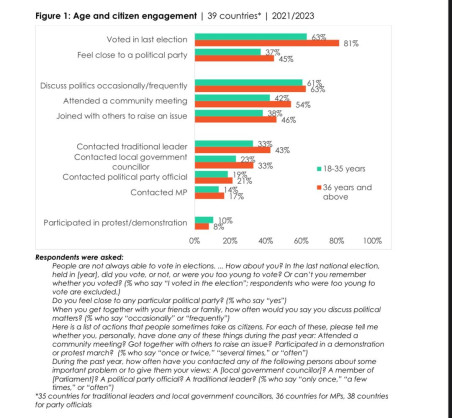
The largest generational disparity is in voting, where the youth (aged 18-35) trail their elders by a striking 18 percentage points. Youth are also less likely to feel close to a political party, to attend a community meeting, to join with others to raise an issue, and to contact traditional leaders and local government councillors.
The report, the second in an annual series on high-priority topics, draws on data spanning the past decade, including the latest round of nationally representative surveys in 39 countries, representing the views of more than three-fourths of the continent’s population. The analysis focuses on 10 key indicators of citizen engagement.
These generational gaps underscore the challenges of political participation on the world’s most youthful continent if governments fail to create channels for meaningful engagement.
The new flagship report, based on 53,444 face-to-face interviews, is accompanied by country scorecards (https://apo-opa.co/414kmO9) on citizen engagement that provide an at-a-glance snapshot of key indicators of citizen participation for each of the surveyed countries.
Afrobarometer survey
Afrobarometer is a pan-African, non-partisan survey research network that provides reliable data on African experiences and evaluations of democracy, governance, and quality of life. Nine survey rounds in up to 42 countries have been completed since 1999. Round 9 surveys (2021/2023) cover 39 countries.
Afrobarometer’s national partners conduct face-to-face interviews in the language of the respondent’s choice. National samples of 1,200-2,400 yield country-level results with margins of error of +/-2 to +/-3 percentage points at a 95% confidence level.
Key findings
- African youth (aged 18-35) are less likely than older generations to attend a community meeting (-12 percentage points), contact traditional leaders (-10 points), contact local government councillors (-10 points), feel close to a political party (-8 points), and join with others to raise an issue (-8 points) (Figure 1).
- The most striking deficit is in voter turnout (-18 percentage points).
- Senegal (-29 percentage points), Cameroon (-28 points), and Zimbabwe (-28 points) exhibit the largest disparities in voting rates by age (Figure 2).
- Attendance at community meetings sees the widest gaps in Côte d’Ivoire (-28 points), Zambia (-26 points), and Botswana (-24 points) (Figure 3).
- When it comes to direct engagement with local government officials, the largest disparities are in Lesotho (-24 points), Zambia (-20 points), Guinea (-16 points), and Kenya (-16 points) (Figure 4).
- Youth are more likely than their elders to participate in protests in many African countries, although rates in 16 countries differ by no more than 1 percentage point (Figure 5).
- Tunisia stands out with the largest gap in protest rates (+17 points), followed by Sudan (+9 points) and São Tomé and Príncipe (+7 points).
Distributed by APO Group on behalf of Afrobarometer.
Link to the full flagship report: https://apo-opa.co/4lrTLSn
For more information, please contact:
Josephine Appiah-Nyamekye Sanny
Director of Communications
Email: jappiah@afrobarometer.org
Telephone: +233 243240933
Social Media:
Facebook
X
LinkedIn
YouTube
Instagram
WhatsApp
Bluesky
Visit us online at www.Afrobarometer.org.
Follow our releases on #VoicesAfrica.