Wednesday, June 17, 2026
  • About
  • Advertise
  • Careers
  • Contact
NewsTrendsKE
  • Business
    • Deals
  • OpEds
  • Sustainability
  • Women in Business
  • Lifestyle
  • Featured
  • Technology
    • Phones
  • Sports
  • World
  • Contact Us
No Result
View All Result
NewsTrendsKE
No Result
View All Result

Home » APO News » Africans call on their governments to pressure rich countries for climate aid, support investment in climate-resilient infrastructure

Africans call on their governments to pressure rich countries for climate aid, support investment in climate-resilient infrastructure

by
2 years ago
in APO News, Featured
Reading Time: 3 mins read
A A
Share on FacebookShare on TwitterShare on WhatsApp
Afrobarometer

Citizens across 22 African countries want their governments to put more pressure on rich and developed countries to help Africans who are affected by climate change, according to a recent Afrobarometer (www.Afrobarometer.org) survey. 

Also Read

NewsTrendsKE with APO News Updates

Under Mission 300, A New Way of Doing Business Connects Over 50 Million People to Electricity Across Africa

17 June 2026
NewsTrendsKE with APO News Updates

Islamic Corporation for the Insurance of Investment and Export Credit (ICIEC) Releases 2025 Annual Development Effectiveness Report, Showcasing Impact in Trade, Investment, Risk Mitigation, and Human Development

17 June 2026
Load More

Africans also overwhelmingly support efforts to invest in climate-resilient infrastructure to withstand extreme floods and droughts. Majorities of citizens report that crop failures and droughts have worsened over the past decade.  

Six in 10 African citizens have heard about climate change, most of whom say that it is making life in their communities worse. Asked who should take primary responsibility for curbing the negative effects of climate change, respondents are most likely to cite their country’s government, followed by wealthy countries and ordinary citizens.

Key findings:  

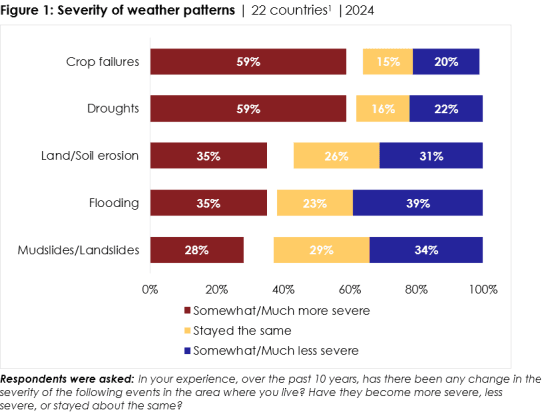
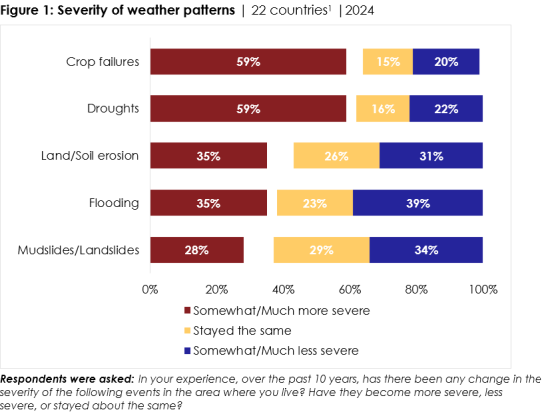
On average across 22 countries, majorities of citizens report that crop failures and drought have become “somewhat more severe” or “much more severe” in their region during the past 10 years (both 59%) (Figure 1).  

  • About one-fifth say droughts (22%) and crop failures (20%) have become less severe in the area where they live. 
  • Assessments vary regarding the intensification of floods, landslides or mudslides, and land or soil erosion.  

Six in 10 Africans (59%) have heard about climate change (Figure 2). 

  • Awareness is particularly high in Mauritius (83%), Gabon (79%), and Malawi (77%), but low in Tunisia (37%) and Tanzania (38%).    

Among those who are aware of climate change: 

  • The overwhelming majority (81%) say climate change is making life in their countries worse (Figure 3). 
  • More than nine in 10 report negative impacts in Mauritius (95%), Zimbabwe (93%), Zambia (93%), and Lesotho (92%).  
  • Asked who should bear primary responsibility for limiting climate change, the most common answer is the respondent’s government (cited by 37%), followed by rich or developed countries (26%) and ordinary citizens (18%) (Figure 4). 

More than three-quarters (77%) of Africans say their governments should put more pressure on rich and developed countries to provide resources to help citizens who are affected by climate change or changes in weather conditions (Figure 5).  

  • An even higher proportion (82%) support investment in climate-resilient infrastructure in response to changing weather patterns and environmental degradation.  

Afrobarometer surveys 

Afrobarometer is a pan-African, non-partisan survey research network that provides reliable data on African experiences and evaluations of democracy, governance, and quality of life. Nine survey rounds in up to 42 countries have been completed since 1999. Round 10 surveys were launched in January 2024. 

Afrobarometer’s national partners conduct face-to-face interviews in the language of the respondent’s choice with samples of 1,200-2,400 adults that yield country-level results with margins of error of +/-2 to +/-3 percentage points at a 95% confidence level.  

[1] The question about the severity of mudslides/landslides was asked in 14 countries, and the question about the severity of land/soil erosion was asked in 16 countries.

[2] The question about promoting electric taxis was asked in 12 countries.

Distributed by APO Group on behalf of Afrobarometer.

For more information, please contact: 
Daniel Iberi 
Afrobarometer communications officer for East Africa 
Email: diberi@afrobarometer.org 
Telephone: +25 472 567 4457  
Visit us online at www.Afrobarometer.org. 

Follow us:
Twitter
Facebook
YouTube
Follow our releases on #VoicesAfrica.

Media files
Afrobarometer
Download logo
Previous Post

How Samsung is Leading the AI Transformation in Key Global Markets

Next Post

President Boakai Issues Clarification on the Role and Authority of Acting Heads of Government Institution

Related Posts

NewsTrendsKE with APO News Updates
APO News

Under Mission 300, A New Way of Doing Business Connects Over 50 Million People to Electricity Across Africa

17 June 2026
NewsTrendsKE with APO News Updates
APO News

Islamic Corporation for the Insurance of Investment and Export Credit (ICIEC) Releases 2025 Annual Development Effectiveness Report, Showcasing Impact in Trade, Investment, Risk Mitigation, and Human Development

17 June 2026
NewsTrendsKE with APO News Updates
APO News

United Nations (UN) Women and the Government of Japan launch new initiative to strengthen gender-responsive disaster preparedness in Tanzania

17 June 2026
NewsTrendsKE with APO News Updates
APO News

Eritrea: Popular campaigns in connection with Martyrs Day

17 June 2026
wedding photographer in Nairobi — Dan Mbugua Photography

Dan Mbugua Photography: A Nairobi Wedding Photographer for Couples Who Want Luxury Quality, Affordable Packages, and Dependable Coverage

17 June 2026
NewsTrendsKE with APO News Updates

Canon Demonstrates Print’s ‘Power to Move’ with On-Stand Experience and Latest Large Format Technologies at Federation of European Screen Printers Associations (FESPA) Global Print Expo 2026

25 May 2026
NewsTrendsKE with APO News Updates

S&P Global Ratings assigns Afreximbank ‘BBB+/A-2’ investment grade rating

15 June 2026

KCSE 2025 KNEC Results Online-Only Access

9 January 2026

How to check your 2024 KCSE results

9 January 2025
NewsTrendsKE with APO News Updates

Islamic Corporation for the Insurance of Investment and Export Credit (ICIEC) Releases 2025 Annual Development Effectiveness Report, Showcasing Impact in Trade, Investment, Risk Mitigation, and Human Development

17 June 2026
NewsTrendsKE

NewsTrendsKE

A News Blog For Readers Who Want More

Follow us on social media:

  • About
  • Advertise
  • Careers
  • Contact

©2026 NewsTrendsKE.

No Result
View All Result
  • Business
    • Deals
  • OpEds
  • Sustainability
  • Women in Business
  • Lifestyle
  • Featured
  • Technology
    • Phones
  • Sports
  • World
  • Contact Us

©2026 NewsTrendsKE.

Go to mobile version