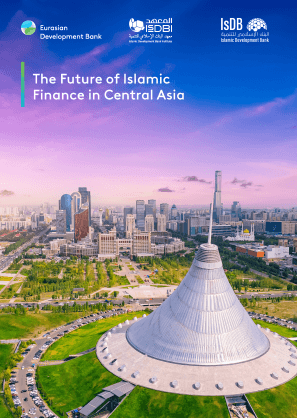

The Eurasian Development Bank, the Islamic Development Bank Institute (www.IsDBInstitute.org) and the London Stock Exchange Group have published a joint research on the future of Islamic finance in Central Asia. The joint research was presented at the 2025 Islamic Development Group’s Annual Meetings in Algiers, Algeria.
Also Read

This report provides a comprehensive analysis of the current status and prospects of Islamic finance globally and in Central Asia, comprising Kazakhstan, Kyrgyzstan, Tajikistan, Turkmenistan, and Uzbekistan. The report makes practical recommendations and strategic considerations tailored to the specific dynamics of the region, addressing regulatory harmonisation, capacity building, product innovation, and awareness campaigns. The research demonstrates that the region offers a unique opportunity for the growth of Sharia-compliant financial products and services, due to its rich cultural heritage, significant Muslim population, and rising demand for investments.
The region of Central Asia (Kazakhstan, Kyrgyzstan, Tajikistan, Turkmenistan, and Uzbekistan) is dynamically changing, and its role in Eurasia and the world needs to be reassessed. The population of Central Asia is 80 million people. This is a 40% increase since 2000. It keeps growing at 2% per year. In 2024, the aggregate GDP of the Central Asia countries was $519 billion). Over the last two decades, it grew nominally at 6.4% on average. Foreign trade turnover has increased almost ninefold since 2000. Foreign direct investments have increased 17 times. For over 20 years, Central Asia has been growing faster than developing countries on average.
Sharī‘ah-compliant financing, as a relatively new (more than 30 years old) and fast-growing segment of the global financial system, plays an increasingly important role in the sustainable development of the Central Asian states. All governments of the region are paying special attention to the development of Islamic finance. Islamic finance offers a unique opportunity for Central Asia to promote inclusive growth, financial stability, and sustainability. Overcoming challenges such as regulatory inconsistencies and talent shortages will require coordinated efforts and innovative solutions. By capitalizing on its strategic advantages, the region can position itself as a key player in the global Islamic finance industry.
The region of Central Asia currently has 11 Islamic banks and 11 non-banking financial institutions, as well as Islamic banking windows. Other institutions include takaful operators, microfinancing, investment companies, Ijara or leasing companies, and Islamic FinTechs such as digital banks and wealth management platforms. Islamic capital market instruments such as ṣukūk are developing more slowly than Islamic financial institutions, however.
Islamic finance assets in Central Asia amount to USD 699 million at the beginning of 2024. According to the Islamic Finance Development Report 2024, Kazakhstan ranks 19th in the world in terms of Islamic finance development in 2024 (i.e. above the global average) and leads the Central Asian market.
In the next ten years, there is a perspective for significant growth and development in the Islamic finance industry in the region, driven mainly by the Islamic banking sector and the ṣukūk asset class (Energy, Transport & Logistics, Industry, Food Security and Social Infrastructure are priority areas of investment). A baseline scenario based on the growth of financial intermediation and an estimate of the change in the share of Islamic finance in the financial sector structure was used to project the increase in Islamic finance assets in the region.
This approach assumes an increase in Islamic banking assets in Central Asia to the level of USD 2.5 billion in 2028 and USD 6.3 billion in 2033. Given the favourable demographics, strong economic growth, and the substantial size of the banking industry in each of the five Central Asian nations, Kazakhstan is expected to be the leader, followed closely by Uzbekistan. The region’s Ṣukūk market is also expected to witness significant expansion: the baseline forecasts suggest that Ṣukūk market is anticipated to grow to USD 2.05 billion by 2028 and USD 5.6 billion by 2033.
The Islamic finance industry faces challenges such as lack of standardisation, and the need for robust risk management frameworks. For that reason, regulatory harmonisation across Central Asian countries is crucial to attract foreign investment and facilitate cross-border transactions.
The report stresses the need for cooperation of the multilateral financial institutions and International Islamic banks on creating Sharia-compliant products and services tailored to the specific needs of Central Asian markets, including development of “Islamic windows” in conventional financial institutions as a sustainability milestone and innovative solutions for microfinance, agriculture financing, and renewable energy financing. International Islamic banks from more mature Islamic finance jurisdictions such as the Gulf countries and Southeast Asia can help build capacity in Central Asian Islamic banking ecosystems and can enable knowledge transfers in Central Asian countries to enhance the levels of Islamic finance technical expertise they can draw upon.
“One of the EDB’s strategic priorities is to become a platform for Islamic finance in Central Asia. The further development of Islamic finance in Central Asia will expand financial inclusion and connect local businesses to the global Islamic market, contributing to regional economic growth. With the Islamic Development Bank Group’s support, EDB has started to develop an “Islamic Window” for financing projects in accordance with Sharia principles. The priority areas of investments will be energy, transport, social infrastructure, food security and industry”, says Mr Nikolai Podguzov, EDB Chairman.
In a message published in the report, Chairman of the IsDB Group, H.E. Dr. Muhammad Al Jasser, said, “The Islamic Development Bank Group is committed to supporting the advancement of Islamic finance in Central Asia and beyond. Our collaboration with Eurasian Development Bank demonstrates how development banks can work together to create inclusive and resilient financial systems.”
The report concludes that Islamic finance holds immense potential to contribute to economic development, financial inclusion, and foster good governance practices in Central Asia. By capitalizing on the region’s unique opportunities and addressing existing challenges through collaborative efforts, Islamic finance can emerge as one more source of sustainable growth and prosperity in the region.
The report “The Future of Islamic Finance in Central Asia” is accessible on IsDBI website here: https://isdbinstitute.org/product/future-of-islamic-finance-in-central-asia/
Distributed by APO Group on behalf of Islamic Development Bank Institute (IsDBI).
About The Eurasian Development Bank (EDB):
The Eurasian Development Bank (EDB) is a multilateral development bank investing in Eurasia. For more than 18 years, the Bank has worked to strengthen and expand economic ties and foster comprehensive development in its member countries. By 2025, the EDB’s cumulative portfolio comprised 305 projects with a total investment of US $16.5 billion. The Bank’s portfolio consists principally of projects with an integration effect in transport infrastructure, digital systems, green energy, agriculture, manufacturing, and mechanical engineering. The Bank’s operations are guided by the UN Sustainable Development Goals and ESG principles.
About The Islamic Development Bank Institute (IsDBI):
The Islamic Development Bank Institute (IsDBI) is the knowledge beacon of the Islamic Development Bank Group. Guided by the principles of Islamic economics and finance, the Institute leads the development of innovative knowledge-based solutions to support the sustainable economic advancement of IsDB Member Countries and various Muslim communities worldwide. IsDBI enables economic development through pioneering research and original economic analysis, human capital development, and knowledge creation, dissemination, and management. The Institute leads initiatives to enable Islamic finance ecosystems, ultimately helping Member Countries achieve their development objectives.