
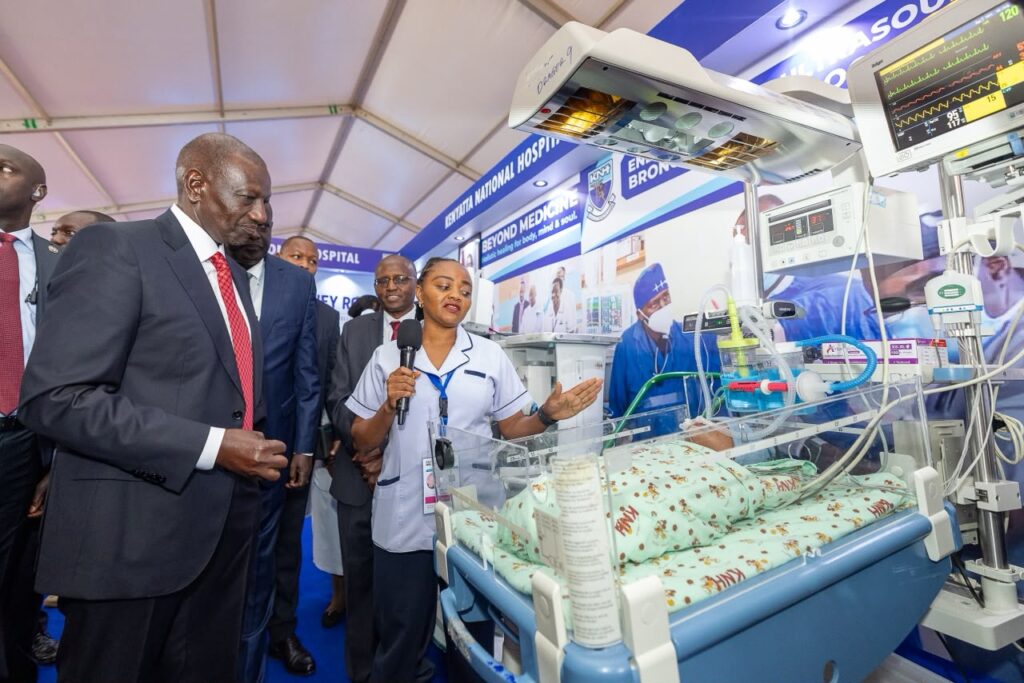
Kenya has outlined new targets to expand health insurance coverage, reduce household medical expenses and increase local pharmaceutical manufacturing as the government reviews four years of health-sector reforms.
The commitments are expected to form part of a Joint Universal Health Coverage Acceleration Plan to be adopted at the close of the two-day Kenya Health Summit, which opened at the Kenyatta International Convention Centre in Nairobi on Tuesday.
The summit has brought together the national and county governments, Parliament, development partners, private healthcare providers, civil society organisations and community representatives.
Under the proposed plan, the government aims to increase enrolment in the Social Health Authority from the reported 32.2 million people to more than 45 million. It also wants to reduce out-of-pocket payments to below 15 per cent of total health expenditure.
Other targets include achieving optimal community health coverage in all counties by June 2027, resolving the framework for managing health workers and increasing locally manufactured products to 75 per cent of supplies distributed by the Kenya Medical Supplies Authority by 2028.
Speaking at the opening ceremony, Health Cabinet Secretary Aden Duale said the summit would assess the government’s health promises against its record since 2022.
“Four years later, we have come to this hall to place that plan side by side with the record, and to invite the whole country to compare the two,” Duale said.
The summit, whose theme is “Reforms Delivered, Health as a Right,” is also expected to adopt a communiqué assigning timelines and responsibilities to institutions involved in implementing the next phase of the reforms.
According to figures released by the Ministry of Health, SHA enrolment has reached 32.2 million people, while the proportion of households protected from catastrophic health expenditure has risen from six per cent to 24 per cent.
The ministry said KSh23.3 billion had been disbursed to health facilities through the Primary Healthcare Fund.
Primary healthcare coverage has also expanded, with 107,831 Community Health Promoters reportedly equipped with smartphones linked to the electronic Community Health Information System. The number of Primary Care Networks has increased from two in 2022 to 278 this year.
On medical supplies, Duale said KEMSA’s national order-fill rate had risen from 35 per cent when the administration took office to 95 per cent.
He attributed the improvement to measures including a KSh10 billion credit facility arranged with Kenya Commercial Bank, the operationalisation of the Embakasi Supply Chain Centre and increased use of digital systems for forecasting, ordering and tracking deliveries.
However, figures in the summit’s press release placed the improvement at 41 per cent to more than 85 per cent. The documents did not explain the difference between the two sets of statistics.
The government says KEMSA now serves more than 11,400 health facilities, with 54 per cent of its supplies going to Level Two and Level Three facilities.
Duale also announced that medical equipment worth KSh9.688 billion had been installed in 247 facilities across 44 counties by July 30.
The installations include 36 CT scanners, two MRI machines, 52 digital X-ray units, 72 ultrasound machines, 157 laboratories, 67 general theatres and 24 dialysis units. Six mammography units and a linear accelerator for cancer treatment have also been installed.
The summit’s press statement said the National Equipment Support Programme had enabled the provision of 1.43 million specialised medical services that were previously inaccessible.
The government also highlighted changes in the health workforce. It said 24,573 healthcare interns had been deployed across the 47 counties since 2022, supported by KSh19.05 billion.
Annual internship placements have increased from 3,373 in the 2022/23 financial year to 6,801 in the current financial year. A further 262 medical registrars have received sponsorship for specialist training in 35 disciplines, while 5,000 nurses and midwives are being recruited under a maternal and newborn health programme.
Duale said 7,414 workers recruited under the Universal Health Coverage programme had been transferred from short-term contracts to permanent and pensionable employment from July 1, at a cost of KSh8.94 billion.
“Security of employment is not only justice for the worker; it is safety for the patient,” he said.
The ministry further reported that 6,171 public health facilities, representing 91.9 per cent of the total, had been digitised. Patient-information portability through the Shared Health Record had reached 58 per cent of facilities.
Other reported health gains include an increase in full childhood immunisation coverage from 78 per cent to 97 per cent and a 37 per cent decline in new HIV infections since 2022. Among people aged between 15 and 24, new infections were reported to have fallen by 41 per cent.
Despite the progress cited by the government, officials acknowledged persistent financing and coverage gaps.
Kenya’s health allocation remains below the Abuja Declaration target of 15 per cent of the national budget, while 14 counties have not achieved optimal community health coverage.
The country must also find domestic funding to sustain HIV, tuberculosis, malaria and family-planning programmes as international donors reduce or restructure their support.
The summit continues through Wednesday, when delegates are expected to adopt the acceleration plan and communiqué.