
Kenya has quietly become one of Africa’s most dynamic hubs for artificial intelligence, driven not by multinationals or foreign consultants, but by its own young innovators. A new study by global technology company Zoho, conducted through Arion Research, reveals that Kenya is not only embracing AI faster than its neighbours but is doing so in a uniquely responsible way — with data privacy and governance at the centre of its transformation.
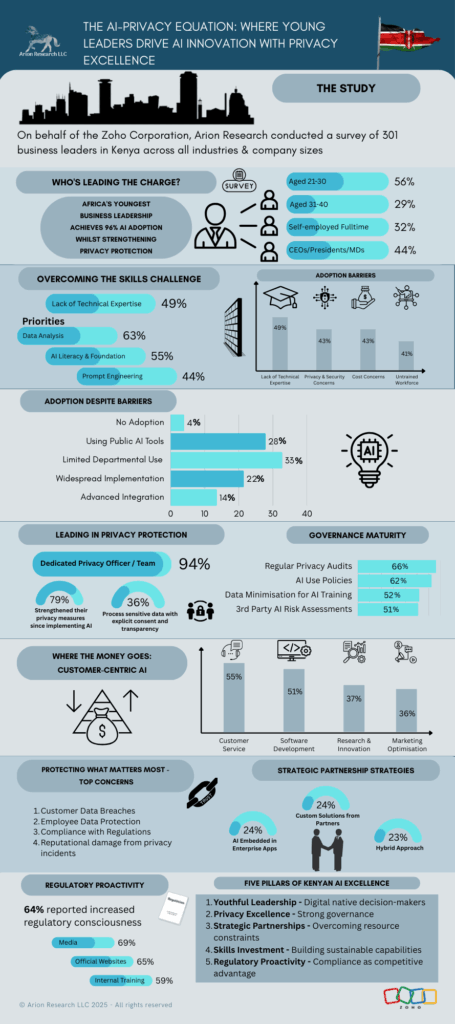
Titled “The AI Privacy Equation: Youthful Innovation Meets Privacy Leadership in Kenya,” the study paints a portrait of a nation redefining what responsible innovation looks like in the digital age. It finds that 96 percent of Kenyan organisations have begun their AI journey — the highest rate recorded in Africa — with more than one in three already achieving advanced or widespread AI implementation.


Even more striking, Kenya’s AI revolution is being led by the youngest decision-makers on the continent, with over half of surveyed leaders aged between 21 and 30, and nearly a third between 31 and 40. In an era when most discussions about AI governance centre on experience and caution, Kenya’s data tells a different story: youthful leadership can be a catalyst for innovation that is both ambitious and ethical.
The Young and the Digitally Native
The country’s emerging generation of business leaders — digital natives raised in the internet era — are shaping corporate decisions in ways that reflect global tech awareness and local realities. Their influence has created a distinct governance model where strategic vision meets technical know-how.
In many Kenyan firms, CEOs and IT leaders collaborate closely to make swift yet informed technology decisions. The study found that 44 percent of AI adoption initiatives are led at CEO level, while 18 percent are driven by IT leadership. This blend of business and technical insight has allowed companies to make bold investments in AI while maintaining robust privacy standards.
“These young leaders are proving that innovation and privacy can evolve together,” said Veerakumar Natarajan, Country Head, Zoho Kenya. “Their approach reflects Zoho’s belief that privacy-first AI not only protects users but also empowers businesses. Kenya’s success shows that robust privacy practices do not slow innovation — they make it sustainable.”
From Compliance to Competitive Advantage
A defining feature of Kenya’s AI ecosystem is its deep commitment to data protection. The study found that 82 percent of organisations have strengthened their privacy measures since adopting AI — the highest improvement rate across Africa.
This achievement is underpinned by strong governance structures. Ninety-four percent of Kenyan organisations now have dedicated privacy officers or teams, and two-thirds conduct regular privacy audits. More than a third carry out quarterly privacy impact assessments, while others ensure reviews are done before implementing new systems.
Such practices are no longer seen as bureaucratic obligations. Instead, they have become strategic investments. Over half of surveyed organisations allocate more than 20 percent of their IT budgets to privacy protection, reflecting a growing belief that trust and compliance are market advantages.
The Kenya Data Protection Act (2019) has been instrumental in catalysing this change. The law has raised regulatory awareness by 64 percent, according to the research, and inspired companies to take ownership of how they handle user data. Unlike in many markets where compliance is reactive, Kenyan organisations are proactively building privacy frameworks that support innovation rather than restrict it.
Strategic Adoption Despite Resource Constraints
Although Kenya leads Africa in AI adoption, the road has not been without challenges. Respondents identified lack of technical expertise (49 percent) and high implementation costs (43 percent) as their top barriers.
Yet, rather than viewing these obstacles as deterrents, Kenyan firms have responded with creativity. Many have adopted pragmatic AI sourcing strategies, blending custom-built solutions, embedded AI within enterprise software, and hybrid approaches. Roughly 24 percent of businesses use custom AI solutions, another 24 percent rely on AI embedded in applications, and 23 percent combine multiple strategies.
This flexibility allows even small and medium enterprises to access powerful AI capabilities without heavy capital investment. As a result, Kenya’s AI market has evolved with remarkable inclusivity, ensuring that technological advancement is not reserved for the elite.
AI adoption has also been strategically focused. Kenyan organisations have prioritised areas that deliver measurable results: customer service (55 percent), software development (51 percent), and marketing optimisation (36 percent). These domains provide immediate impact, improve customer experiences, and streamline internal operations — making them ideal for early AI integration.
Privacy as the Cornerstone of Trust
The link between AI and privacy is not merely regulatory; it is cultural. In Kenya, privacy is becoming a defining value of digital business. The survey revealed that most companies view privacy governance as a competitive differentiator that builds customer trust and brand loyalty.
Arion Research CEO Michael Fauscette, who led the study, highlighted the global significance of Kenya’s approach. “Kenya’s AI adoption story offers three critical lessons for emerging markets. First, youth is not a liability in technology governance; it is an asset when combined with strong frameworks. Second, privacy protection and rapid innovation are not trade-offs — they reinforce each other. Third, resource constraints drive creative implementation models that can be more sustainable than resource-heavy approaches.”
This shift from compliance-driven to trust-driven privacy is reshaping how businesses operate. With data breaches and AI misuse dominating global headlines, Kenya’s stance is a refreshing contrast: privacy-first innovation can be profitable and ethical.
The Upskilling Imperative
Kenya’s AI transformation is not solely technological — it is human. Organisations are investing heavily in skills that support sustainable innovation.
According to the study, 63 percent of firms prioritise data analysis and interpretation training, 54.5 percent focus on AI literacy, and 44 percent are training staff in prompt engineering — a crucial skill for the generative AI era.
Beyond technical knowledge, training extends to process optimisation (33 percent), technical integration (32 percent), and AI ethics (30 percent). This holistic approach recognises that successful AI deployment depends not only on algorithms but also on the people managing and interpreting them.
Such preparation reflects Kenya’s understanding that technology alone does not deliver transformation — informed people do. By equipping employees to engage with AI responsibly, Kenyan organisations are ensuring long-term sustainability and societal acceptance of the technology.
Government and Industry Collaboration
The Kenyan government’s proactive stance on digital transformation has supported private-sector innovation. The enforcement of the Data Protection Act and the establishment of the Office of the Data Protection Commissioner (ODPC) have provided clarity and accountability.
However, the Zoho-Arion report suggests that public-private collaboration can go even further. It recommends the creation of regulatory sandboxes that allow safe AI experimentation, sector-specific guidelines for responsible adoption, and public awareness campaigns to deepen understanding of AI governance.
These initiatives would reinforce Kenya’s leadership and provide a roadmap for neighbouring countries seeking to balance technological progress with privacy protection.
The Emerging Kenyan Model
What emerges from the study is what Arion Research calls “The Kenyan Model” — a framework built on five pillars:
- Youthful Leadership: A generation of tech-savvy leaders under 40 driving AI strategy and adoption.
- Privacy Governance Excellence: Near-universal appointment of privacy officers and adherence to audits.
- Strategic Resource Optimisation: Innovative sourcing and hybrid models overcoming financial and expertise gaps.
- Capability Development: Comprehensive training focused on both technical and ethical AI literacy.
- Regulatory Engagement: Active alignment with national data protection frameworks.
This model demonstrates that emerging economies can lead responsibly without mimicking Western blueprints. Kenya’s approach combines agility, inclusivity, and accountability, proving that strong governance need not stifle innovation.
Lessons for Africa and Beyond
Kenya’s achievements carry lessons for other African nations pursuing digital transformation. The report suggests that countries can “leverage Kenya’s privacy governance expertise as a model for regional AI investments” and that policymakers should support “reverse mentoring programmes” where young digital leaders help shape national AI strategies.
For investors and international partners, the message is equally clear: Kenya’s privacy-first AI market is not only compliant but also commercially promising. The country’s 96 percent AI adoption rate and 94 percent privacy governance participation demonstrate a rare blend of speed and responsibility.
If Kenya maintains its trajectory, it could soon emerge as East Africa’s centre of excellence for ethical AI development, influencing regional standards and fostering cross-border collaboration.
A Vision for the Future
As AI systems increasingly define how societies function — from healthcare to banking, from education to agriculture — Kenya’s example offers reassurance that technology can evolve responsibly. The youthful leadership driving this transformation represents not only a demographic shift but a philosophical one: that innovation must serve people, not the other way around.
Kenya’s AI story is not about blind adoption or Silicon Valley imitation. It is about local ingenuity meeting global opportunity, guided by a moral compass that values privacy, trust, and inclusivity.
The journey ahead will not be without challenges — technical expertise gaps, infrastructure limitations, and evolving regulations will continue to test the system. But the foundations are strong, and the intent is clear.
In a world struggling to reconcile the promises and perils of artificial intelligence, Kenya is charting its own path — one that others might soon follow. It is a reminder that sometimes, the future of responsible technology does not come from the world’s richest nations, but from its youngest leaders, armed with ideas, conviction, and a deep respect for privacy.