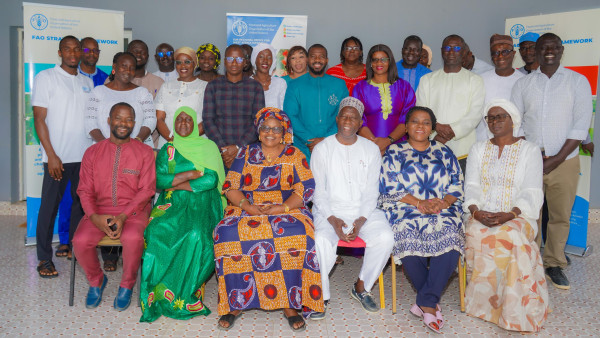

The Food and Agriculture Organization of the United Nations (FAO), in collaboration with the Association of Journalists in Health, Population and Development (AJSPD), organized a five‑day capacity‑building workshop in Thiès (June 16–20, 2025) to train Senegalese media professionals on food safety issues. The training aimed to deepen their understanding of the key challenges, legal frameworks, technical tools, and best practices related to food safety.
In her opening remarks, Mrs Bintia Stephen‑Tchicaya, FAO’s Acting Sub‑Regional Coordinator for West Africa, complimented AJSPD for its outstanding work in health and development journalism. “You are essential actors in building a culture of prevention and responsibility around food safety. Through your investigations, reports, and columns, you can shift mindsets, influence behaviors, and hold decision makers to account. We count on your renewed commitment to consistently include food safety in your reporting,” she said.
Food safety remains a major challenge across Africa. According to a 2015 WHO estimation, more than 91 million people in Africa fall ill annually from foodborne illnesses, resulting in around 137 000 deaths. These alarming figures highlight the urgent need to raise public awareness and influence policymakers, professionals, and consumers alike.
Professor Amadou Diop, Chair of the National Codex Committee in Senegal, reminded participants that the Codex Alimentarius – fully endorsed by Senegal – sets rigorous, science‑based international food safety standards. “These standards only have impact,” he said, “if they are understood, communicated, and applied – especially by media professionals. Journalists are not only messengers but educators, preventers, and mobilizers who can translate complex scientific data into accessible, actionable messages.”
The workshop featured theoretical lectures, panel discussions, case studies, and practical field work. Journalists visited Thiès’s main transport hub to assess street food safety issues firsthand. Captain Armand Seck of the Thiès hygiene brigade reported numerous violations: cramped stalls, poor ventilation, inadequate lighting, and makeshift food stands under tarpaulins.
Recognizing the lack of formal training among journalists on food safety, the program covered legal frameworks, international standards like Codex, microbiological, physical, and chemical hazards, surveillance systems, and safe handling practices for food preparation and sale.
Participants proposed several recommendations to improve communication, awareness, and advocacy: fostering stronger collaboration between media, health authorities, and partners; organizing regular specialized training; publicizing safe food-handling practices; educating policymakers including parliamentarians; and creating regional professional networks.
This workshop marks an important milestone in promoting quality information on food safety to benefit consumers in Senegal and across West Africa. It is part of the project “Strengthening capacity to respond to food safety emergencies and improving street food quality in Burkina Faso, Mali, and Senegal,” funded by the Grand Duchy of Luxembourg, with the goal of enhancing emergency response to food safety threats and improving street food hygiene standards in West Africa.
Distributed by APO Group on behalf of Food and Agriculture Organization of the United Nations (FAO): Regional Office for Africa.