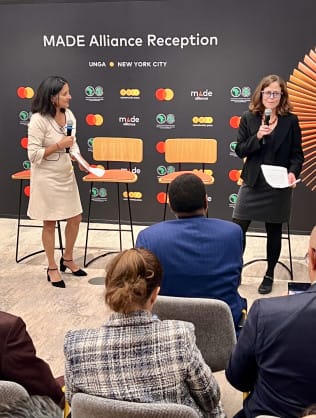
The African Development Bank Group (www.AfDB.org) and Mastercard are co-chairing a new initiative called Mobilizing Access to the Digital Economy (MADE) Alliance Africa, which aims to provide digital access to critical services for 100 million people and businesses in Africa over the next 10 years. In the first phase of its $300 million commitment to the Alliance’s initial five years of programming, the African Development Bank aims to bring 3 million farmers in Kenya, Tanzania and Nigeria into the digital economy via Mastercard Community Pass. Community Pass gives farmers a digital credential to access a network of digital agricultural agents.


Alliance members include Equity Bank Group, Microsoft, Heifer International, Sustainable Agriculture Foundation, Unconnected.org, Yara, Kenya National Farmers’ Federation, Shell Foundation, and CRDB Bank. The Alliance also utilizes financial support from the U.S. Agency for International Development.
For World Food Day, we asked African Development Bank Vice President for Agriculture, Human and Social Development, Dr. Beth Dunford, about the possibilities digitalization brings to Africa’s farmers and food systems.
Why did MADE Alliance Africa choose to focus on the digitization of agriculture for smallholder farmers and women as its first initiative, and why do you think the African agriculture sector holds so much potential?
Dunford: Africa is home to 65% of the planet’s remaining uncultivated, arable land, and we believe that agriculture is a critical sector to drive Africa’s development. Agriculture accounts for nearly 60% of total employment in Africa and accounts for more than 25% of GDP in its low-income countries. Across the continent, there’s no agriculture without women. They provide an estimated 60% to 80% of labor input to the sector. Growth in agriculture is terribly effective compared to many other sectors in lifting people out of poverty, providing degrees of agency to women, feeding Africa’s people, and positioning the continent as a breadbasket to the world.
Our challenge is that the majority of Africa’s food systems producers are smallholder farmers who, simply put, struggle from season to season due to a lack of access to quality inputs like seeds and fertilizer, or access to affordable financing to purchase farming necessities. Africa’s smallholder farmers have various needs that the MADE Alliance Africa can solve by boosting sustainable digital access to critical services. Through the MADE Alliance, Mastercard Community Pass works with local banks to provide digital credentials to millions of smallholder farmers and women. Digital identities are the gateway to accessing digital services and to high-quality inputs. Digitalizing agriculture and the distribution of goods will bring enormous efficiencies to the marketplace, as well as reduce waste and fraud across the ecosystem.
Mastercard’s Community Pass can help establish digital credentials for millions of farmers, bring more transparency to pricing and help them access agricultural inputs. What are the challenges involved in bringing this solution to market, and how can they be overcome?
Dunford: Community Pass is designed to operate in remote and rural communities — often with limited connectivity and energy access. This technology, to adapt a popular phrase, “meets farmers where they are.” However, there are challenges involved in delivering these solutions and connecting smallholder farmers and women to financial institutions — challenges that we believe can be overcome or mitigated through capacity building, infrastructure and new models for governments and the private sector to work together.
To scale these technologies to more farmers in a timely manner, we need to work with farmer cooperatives and networks of member farmers who reap many benefits of doing business as a unit. The challenge is that the majority of farmer cooperatives in Africa are not as operationally efficient as they are in other regions, and the prevalence of digital literacy is relatively low. Africa needs significant investment to educate farmers on how they can benefit from digital technologies to access resources.
MADE Alliance’s digital services can connect farmers to new buyers and suppliers who are physically far away, but costs to transport goods to market remain a barrier. Critically, farmers and women need digital devices and reliable connectivity to take advantage of the digital economy.
Can you talk a little more about how the MADE Alliance will benefit women?
Dunford: Roughly half of Africa’s smallholder farmers are women, with the majority of agriculture sector labor carried out by women. However, compared to their male counterparts, female farmers struggle to create a sustainable livelihood in agriculture because they are less likely to own property titles or other assets often needed to access financial services. Women farmers have less access to information and extension services, and they lack access to inputs such as seeds and fertilizers. They are disproportionately impacted by climate risks. Collectively, these challenges result in women farmers typically producing up to 20% to 30% less output than male farmers.
Community Pass helps women make farming a sustainable livelihood by enabling access to critical service providers like banks and agricultural buyers, as well as creating transparency.
Women are the backbone of African economies, and investing in women entrepreneurs fosters women’s empowerment and agency over decisions around business, family and community. Investing in Africa’s women entrepreneurs is smart economics. Investing in Africa’s women has been a cornerstone of the Bank’s work. In fact, no Bank project or program will receive Bank financing unless it details how it will benefit women.
Distributed by APO Group on behalf of African Development Bank Group (AfDB).