

The United States remains a longstanding and valued partner of Africa in disease surveillance, emergency response, workforce development and global health security.
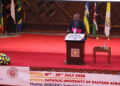

In March 2025, amid major shifts affecting USAID and other health programmes, Africa CDC engaged the US Government through a high-level dialogue at the Department of State involving multiple American to agencies. Meeting Africa CDC – US team (https://apo-opa.co/496EB1I). Africa CDC advocated for a new partnership model grounded in sovereignty, shared responsibility and sustainability, in which the US increasingly channels support through direct country funding while African governments progressively expand domestic co-financing for health systems and health security priorities.
Africa CDC also recalls the consensus reached by the African High-Level Ministerial Committee on Global Health Architecture, which convened in Geneva on 17 May 2026, bringing together 48 African ministers from all five regions of the continent. Ministers agreed that future strategic negotiations related to continental health security partnerships should increasingly be coordinated through Africa CDC to strengthen African solidarity, policy coherence, and alignment among Member States.
From the earliest stages of the current Ebola outbreak, Africa CDC acted rapidly, transparently, and responsibly. Following confirmation that at least two countries were affected, the agency exercised its continental mandate to declare this outbreak on 15 May 2026, elevating political attention and accelerating coordination across Africa. Since the beginning of the outbreak, Africa CDC has maintained continuous information sharing with Member States, partners, media, and the international community, with more than 1,600 global media citations referencing Africa CDC data and technical updates.
Africa CDC takes note of the US Government’s decision to issue a Level 4 “Do Not Travel” advisory for the DRC and to impose entry restrictions on non-US passport holders who have recently travelled to the DRC, Uganda or South Sudan. The agency fully recognises the sovereign responsibility of every government to protect the health and security of its people. Our concern is not with the objective of protecting populations, but with the use of broad travel restrictions as a primary public health tool during outbreaks.
Public health measures during outbreaks must be guided by science, proportionality, transparency, international cooperation, and international health regulations. Africa CDC’s position is clear: generalised travel restrictions and border closures are not the solution to outbreaks. Such measures can create fear, damage economies, discourage transparency, complicate humanitarian and health operations, and divert movement toward informal and unmonitored routes – potentially increasing public health risks rather than reducing them.
“The fastest path to protecting all countries in the world is to aggressively support outbreak control at the source,” said H.E. Dr Jean Kaseya, Africa CDC Director General. “Global health security cannot be achieved through borders alone. It is achieved through partnership, trust, science and rapid investment in preparedness and response capacity.”
This current Ebola outbreak highlights a deeper structural injustice in global health innovation: the Bundibugyo Ebolavirus was identified nearly two decades ago, yet no licensed vaccines or therapeutics specific to this strain exist today. Africa CDC believes that if this disease had predominantly threatened wealthier regions of the world, medical countermeasures would likely already be available.
The world witnessed a similar reality during the West African Ebola outbreak, when solutions were disclosed when an American doctor was infected, while thousands of Africans had already died without support. The world must not repeat the same mistake today.
The declaration of the PHECS on 18 May 2026, Africa CDC Official Website, was intended to mobilise political leadership, resources, and coordinated continental action. It is not a signal for panic, but a call for solidarity, urgency and collective responsibility.
Africa CDC is calling for intensified international support for:
- Strengthened cross-border preparedness and regional coordination;
- Sustained support to frontline health workers and Ministries of Health;
- Support risk communication and strong community engagement;
- Expansion of Bundibugyo Ebolavirus laboratory diagnostics and genomic sequencing;
- Deployment of epidemiologists and emergency response experts;
- Increased financing for surveillance, logistics, infection prevention and case management, including the capacity to isolate cases and to organise dignified burials;
- Accelerated development of vaccines, diagnostics and therapeutics for all Ebola strains;
Africa CDC is fully mobilised to support the DRC, Uganda, South Sudan, Rwanda and all at-risk Member States. Africans must know that the agency stands with them – not only to respond to outbreaks and strengthen public health systems, but also to defend their dignity, sovereignty, and collective security under the framework of Africa Health Security and Sovereignty (AHSS). Africa CDC – Africa Health Security and Sovereignty (AHSS) (www.AfricaCDC.org)
This position is consistent with Africa CDC’s previous actions. During the Marburg outbreak in Rwanda in 2024, Africa CDC publicly opposed travel measures that penalised transparency and effective outbreak control and welcomed the lifting of the U.S. travel notice after Rwanda demonstrated strong containment. Africa CDC Statement on Rwanda Marburg Response (www.AfricaCDC.org)
Africa CDC, therefore, calls on all countries – both within Africa and globally – to refrain from imposing unnecessary travel or trade restrictions in response to this outbreak. The world must avoid repeating the mistakes of previous health emergencies, where fear-driven measures caused major economic damage without delivering proportionate public health benefits.
Africa needs solidarity, not stigma. Africa needs investment, not isolation. Africa needs partnerships that strengthen both economies and health systems.
No one is safe until Africa is safe. And Africa is safer when the world invests in African health security, trusts African institutions, and works with Africa as a full partner.
Distributed by APO Group on behalf of Africa Centres for Disease Control and Prevention (Africa CDC).
Media Contact:
Wilson Johwa
Senior Communications Officer
Directorate of Communication & Public Information
JohwaW@africacdc.org
Follow Africa CDC:
LinkedIn: https://apo-opa.co/4uhyxvB
X: https://apo-opa.co/4nB30SS
Facebook: https://apo-opa.co/4eWbbXQ
YouTube: https://apo-opa.co/4dwrnfR
About Africa CDC:
The Africa Centres for Disease Control and Prevention (Africa CDC) is the public health agency of the African Union. As an autonomous institution, Africa CDC supports AU Member States to strengthen health systems, improve disease surveillance, and enhance emergency preparedness and response. For more information, visit: www.AfricaCDC.org.