Friday, October 23, 2026
  • About
  • Advertise
  • Careers
  • Contact
NewsTrendsKE
  • Business
  • Deals
  • Investments
  • Real Estate
  • Economy
  • OpEds
  • Lifestyle
  • Sustainability
  • Women in Business
  • Technology
    • Phones
No Result
View All Result
NewsTrendsKE
No Result
View All Result

Home » APO News » Majority of Africans see pollution as a serious problem, believe in shared responsibility for containing it, Afrobarometer study shows

Majority of Africans see pollution as a serious problem, believe in shared responsibility for containing it, Afrobarometer study shows

Queen Amber by Queen Amber
2 years ago
in APO News, Featured
Reading Time: 3 mins read
A A
Share on FacebookShare on TwitterShare on WhatsApp
Afrobarometer

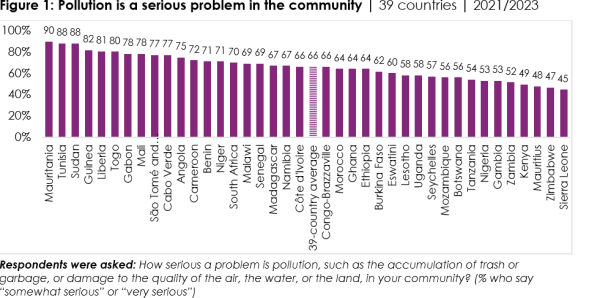
A majority of citizens across 39 African countries say environmental pollution is a serious problem in their communities, an Afrobarometer (www.Afrobarometer.org) study reveals.


Also Read

Peter Ndegwa

Safaricom CEO Reveals What’s Next for M-PESA as Firm Bets on AI and Financial Services

23 October 2026
From L to R: Prof. Jessie Githang'a, Kenya Team Leader for the Early Warning Signs and Symptoms (EWSS) Project; Dr Joyfrida Chepchumba, Childhood Cancer Focal Person at the Ministry of Health; and Dr Doreen Karimi-Mutua, Paediatric Haematologist-Oncologist at Gertrude's Children's Hospital and Principal Investigator of the research, discuss key takeaways during the preliminary dissemination of research findings for the study on Factors Influencing Health-Seeking Behaviour Among Caregivers of Children with Cancer in Kenya, held at PrideInn Azure, Nairobi.

Financial and Geographical Barriers Keep Caregivers from Seeking Timely Childhood Cancer Care in Kenya, Study Reveals

22 October 2026
Load More

Trash disposal, including plastic waste; deforestation; pollution of water sources; poor sanitation or human waste management; and air pollution are cited as the most important environmental concerns in local communities.

Africans are most likely to point to members of the public as bearing the primary responsibility for limiting pollution. But a vast majority also want their governments to do more to protect the environment, with nearly universal support for this view in Tunisia. The only countries where this position is not endorsed by a majority are Namibia and Mauritania.

Africans are slightly more likely to see the benefits of natural resource extraction as outweighing its costs, but there is widespread agreement that the industry should be more tightly regulated.

Key findings

  • On average across 39 countries, two-thirds (66%) of Africans say environmental pollution is a serious problem in their communities (Figure 1).
  • Citizens identify trash disposal, including plastics, as the leading environmental problem in their communities (cited by 27%), followed by deforestation (19%) and water pollution (17%) (Figure 2).
    • Deforestation (28%) stands out as the foremost environmental concern in rural areas, while trash disposal (37%) tops the list in urban communities. 
  • Almost half (46%) of respondents say ordinary citizens bear the primary responsibility for reducing pollution and keeping communities clean, but nearly as many believe that the government – either national (24%) or local (19%) – should take the lead. Only a handful assign a primary role to business and industry (5%) (Figure 3).
  • A significant plurality (45%) of Africans say the benefits of natural resource extraction, such as jobs and revenue, outweigh the costs, such as pollution. But 38% believe the costs are greater and a notable minority (17%) are undecided on this issue (Figure 4).
    • Three-quarters (76%) want their governments to regulate natural resource extraction more tightly to reduce negative environmental consequences.
  • An overwhelming majority (78%) want their governments to do more to limit environmental pollution (Figure 5).
    • This sentiment is nearly universal in Tunisia (97%) and reaches nine in 10 citizens or more in Kenya (91%), Cote d’Ivoire (90%), Eswatini (90%), and Guinea (90%).
    • The only countries where this position does not receive majority support are Namibia (49%) and Mauritania (45%).

Afrobarometer surveys

Afrobarometer is a pan-African, non-partisan survey research network that provides reliable data on African experiences and evaluations of democracy, governance, and quality of life. Nine survey rounds in up to 42 countries have been completed since 1999. Round 9 surveys (2021/2023) cover 39 countries.

Afrobarometer’s national partners conduct face-to-face interviews in the language of the respondent’s choice that yield country-level results with margins of error of +/-2 to +/-3 percentage points at a 95% confidence level.

Distributed by APO Group on behalf of Afrobarometer.

For more information, please contact:
Daniel Iberi
Afrobarometer communications officer for East Africa
Email: diberi@afrobarometer.org
Telephone: +25 472 567 4457
Visit us online at www.Afrobarometer.org.

Follow us:
Twitter
Facebook
YouTube
Follow our releases on #VoicesAfrica.
Media files
Afrobarometer
Download logo
Previous Post

Majority of Africans see pollution as a serious problem, believe in shared responsibility for containing it, Afrobarometer study shows

Next Post

The Royal African Society Benefit Gala Auction supported by ARTSY Bidding Starts Now

Related Posts

Peter Ndegwa
Technology

Safaricom CEO Reveals What’s Next for M-PESA as Firm Bets on AI and Financial Services

23 October 2026
From L to R: Prof. Jessie Githang'a, Kenya Team Leader for the Early Warning Signs and Symptoms (EWSS) Project; Dr Joyfrida Chepchumba, Childhood Cancer Focal Person at the Ministry of Health; and Dr Doreen Karimi-Mutua, Paediatric Haematologist-Oncologist at Gertrude's Children's Hospital and Principal Investigator of the research, discuss key takeaways during the preliminary dissemination of research findings for the study on Factors Influencing Health-Seeking Behaviour Among Caregivers of Children with Cancer in Kenya, held at PrideInn Azure, Nairobi.
Health

Financial and Geographical Barriers Keep Caregivers from Seeking Timely Childhood Cancer Care in Kenya, Study Reveals

22 October 2026
Samsung Galaxy Watch Ultra Named Best Upgrade Pick For 2025
Technology

5 Things You Probably Didn’t Know Your Galaxy Watch9 Could Do

22 October 2026
Pink Polo Tournament
Deal

Mercedes-Benz Announced Official Car Sponsor of the Pink Polo Tournament

22 October 2026
Peter Ndegwa

Safaricom CEO Reveals What’s Next for M-PESA as Firm Bets on AI and Financial Services

23 October 2026

LOOP Safari Gravel Series Reaches 10,000-Tree Conservation Milestone

22 October 2026
Samsung Galaxy Watch Ultra Named Best Upgrade Pick For 2025

5 Things You Probably Didn’t Know Your Galaxy Watch9 Could Do

22 October 2026
Pink Polo Tournament

Mercedes-Benz Announced Official Car Sponsor of the Pink Polo Tournament

22 October 2026
Kenya Airways E190

Kenya Airways Partners with Art of Luxury to Expand Premium Customer Experiences

22 October 2026
The Government of Kenya and The Nature Conservancy unveil US$160m Thamani Asili community

The Government of Kenya and The Nature Conservancy unveil US$160m Thamani Asili community conservation Initiative

21 October 2026
NewsTrendsKE

NewsTrendsKE

NewsTrendsKE: the business intelligence read for Kenya's decision-makers.

Follow us on social media:

  • About
  • Advertise
  • Careers
  • Contact

©2026 NewsTrendsKE.

No Result
View All Result
  • Business
  • Deals
  • Investments
  • Real Estate
  • Economy
  • OpEds
  • Lifestyle
  • Sustainability
  • Women in Business
  • Technology
    • Phones

©2026 NewsTrendsKE.

Go to mobile version