
Africa’s urban population will triple in the next 25 years and African countries will need to invest up to 5.5 percent of their gross domestic product (GDP) in urban development if they are to avoid rapid growth of shanty towns.

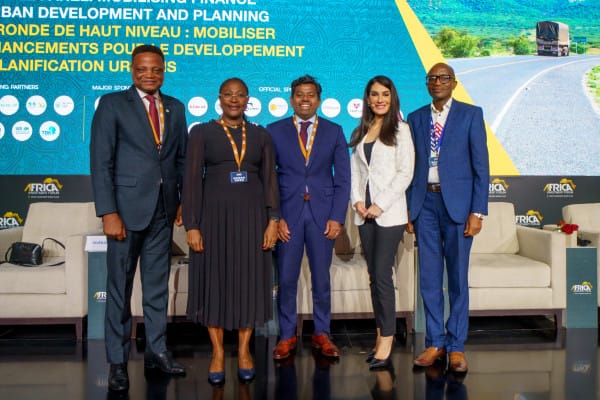
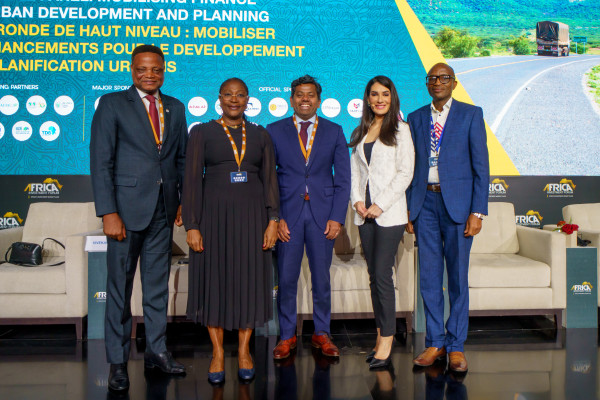
This was the conclusion shared by experts at a round-table discussion, “Mobilising finance for urban development and planning” which took place at the Africa Investment Forum, held from 4-6 December in Rabat, Morocco.
Hastings Chikoko, Senior Director for Cities at Big Win Philanthropy, a charitable foundation focused on development projects in Africa, drew attention to the phenomenon of galloping and poorly controlled urbanisation: “Unfortunately, people will continue to move to cities. What needs to be done?” he asked.
“The problem is a failure of planning, which leads to a lack of housing infrastructure and the emergence of shanty towns,” said Eric Gumbo, Associate Director of law firm G&A Advocates LLP in Kenya. “Our countries have no margin for financing and this impacts our cities. African countries have a debt/GDP ratio of around 65 percent,” Mr Gumbo added.
Abimbola Akinajo, Managing Director of Lagos Metropolitan Area Transport Authority (LAMAT) in Nigeria, confirmed that many big African cities are experiencing the same reality, which is an acute lack of funding.
The panellists agreed that the key challenge is to multiply sources of investment by greater use of the private sector, development finance institutions, investment funds and pension funds, in addition to state and municipal resources.
Diversification of investment needs to go hand in hand with appropriate measures and provisions put in place by national governments and urban authorities: better governance of cities, better planning, capacity-building to enable the design of bankable projects, better planning of municipal investments, and modernisation of revenue collection. Payment by users for various services (motorway tolls, etc.) could help to finance these provisions.
Ednick Muswell, head of the water and sanitation department in eThekwini, an urban municipality in Kwazulu with population of four million and a budget of $3.9 billion, showcased eThekwini as an example of successful urban management in Africa: “We have no debt to ESKOM (the public electricity company) and our budget discipline is a result of good management. The municipality has a good credit rating and investors believe in us.” Muswell added that American pension funds and banks are ready to invest in eThekwini, which is also capable of raising funds on capital markets.
However, other cities on the continent are the victims of poor and biased perception of risk by investors in Africa which has cost implications, according to Chikoko.
“It is expensive to borrow in Africa and unless we find a way of addressing this problem, cities will not have the resources to develop,” he warned.
Mohan Vivekanandan, Executive Director of the Development Bank of Southern Africa (DBSA), a founding partner of the Africa Investment Forum, said that cities must have a well-thought-out plan in order to attract investors: “Major projects must be led by cities, and they must be designed so that the private sector will find it profitable to invest in your city,” he said.
Investor appetite
Abdouraman Diallo, Managing Director of the African Solidarity Fund, believes that the enormous needs of African cities for roads, housing, water and sanitation, cannot be met without strong support from financing institutions.
Capital markets are also adapting to the new norms associated with the development of cities.
“We need to think ahead,” said Nezha Hayat, President of the Moroccan Capital Market Authority, which has adopted a regulatory framework tailored to the needs of the local market, developing green bonds (2016) and municipal bonds that have been helping the city of Agadir to attract investment from capital markets since 2020.
Thierno Habib-Hann, Managing Director of Shelter Afrique Development Bank (ShafDB), pointed out that Africa needs 53 million more homes and that $1000 billion are required in order to create them. His institution, which covers 44 African countries, works in the urban housing value chain and Mr Habib-Hann emphasised that low-cost houses (up to $10,000) are a viable solution thanks to appropriate construction technologies. He called on investors to come to Africa, where the housing market alone is worth $700 to 800 billion.
Solomon Quaynor, Vice President of the African Development Bank Group with responsibility for the Private Sector, Infrastructure and Industrialisation, closed the session by reminding the Forum that the Bank is working to connect urban entities with competitively priced financing and is supporting municipalities in the development of public-private partnerships. He noted that six projects worth more than $4 billion in total had attracted investor interest during boardroom meetings at the Africa Investment Forum.
Distributed by APO Group on behalf of African Development Bank Group (AfDB).
More images: https://apo-opa.co/4glcsoK
About the African Development Bank Group:
The African Development Bank Group (AfDB) is Africa’s premier development finance institution. It comprises three distinct entities: the African Development Bank (AfDB), the African Development Fund (ADF) and the Nigeria Trust Fund (NTF). On the ground in 34 African countries with an external office in Japan, the AfDB contributes to the economic development and the social progress of its 54 regional member states. For more information: www.AfDB.org