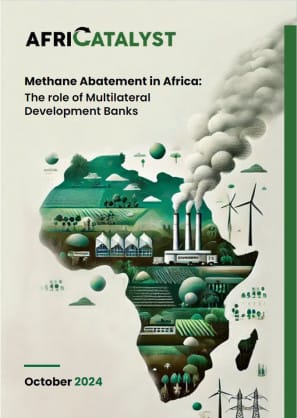
As methane emissions across Africa continue to rise and existing financing falls short of meeting international climate goals and fulfilling the Paris Agreement, the role of multilateral development banks (MDBs) is becoming increasingly important in supporting methane reduction initiatives across the continent.


A new study by AfriCatalyst reveals that Multilateral Development Banks (MDBs) would need to allocate just 2.4% of their assets to meet the $48 billion annual funding requirement for reducing methane emissions by 2030 (https://apo-opa.co/4eo01XT). Methane emissions pose a significant, but underfunded, threat to Africa’s climate resilience, with the continent receiving only about 1% of global climate finance in 2021-2022—roughly $13.7 billion.
Targeted financing for methane abatement could yield significant benefits for the continent, addressing both environmental and health impacts. For example, achieving a 50% reduction in methane emissions by 2030 in the 19 countries responsible for 80% of Africa’s methane emissions would require $10 billion, but would result in an estimated $4,300 per ton of methane avoided in economic and social benefits.
Methane emissions in Africa largely come from agriculture (50.6%), energy (34.2%), and waste (15.2%), with the greatest concentration found in just 19 countries. As methane has a global warming potential 80 times greater than carbon dioxide, it is a major contributor to climate change, driving extreme weather events, poor air quality, and health issues such as respiratory diseases.
“The energy sector, which holds the greatest potential for methane reductions, received less than 1% of that funding. Given the limited financial resources of many African countries, it is imperative to find sustainable solutions that support the transition to more sustainable energy systems and eco-friendly production and consumption models. Multilateral Development Banks (MDBs) must play a central role in developing mechanisms, practices, and innovative instruments for methane abatement.” outlines the new report.
The report Methane Abatement in Africa: The Role of Multilateral Development Banks highlights policy frameworks and financing measures MDBs can adopt to support methane reduction projects in Africa and bridge the funding gap and align with the Paris Agreement targets.
These include tariff regulation for methane emissions in the energy sector, operationalizing local carbon markets, mobilizing additional financing through MDB Capital Adequacy Framework (CAF) reforms, and allocating local currency finance for methane projects.
Key Findings
- To meet the $48 billion annual funding requirement for reducing methane emissions by 2030, MDBs would need to allocate only 2.4% of their assets.
- With Africa currently utilizing only 2% of its annual carbon credit potential, with most credits concentrated in a few countries, MDBs can play a catalytic role in establishing local carbon markets, mobilizing financial resources, and expanding market participation.
- Modernizing financial governance is crucial to enhancing MDBs’ commitment to climate goals, especially in developing countries where climate financing capacity is often limited.
The report also summarizes how new and existing reforms and initiatives can help MDBs take a more prominent role in supporting African countries’ methane reduction efforts as the 2030 deadline approaches and urgent action is needed.
“Methane is a leading contributor to greenhouse gas emissions, and there is strong evidence that with ambitious methane abatement efforts in Africa, the continent can meet its commitments under the Paris Agreement,” said Daouda Sembene, CEO of AfriCatalyst. “However, one of the major challenges we face is the limited awareness and debate surrounding methane abatement in Africa. While the issue is discussed, it’s not yet fully mainstreamed across the continent” he added.
To access the full findings and recommendations read the policy paper: https://apo-opa.co/4eo01XT
Distributed by APO Group on behalf of AfriCatalyst.
For more information and media interviews, please contact:
Fifi Esther Ahonhede
Communications and Projects Officer, AfriCatalyst
Email: fahonhede@africatalyst.com
About Africatalyst:
AfriCatalyst is an independent, global development advisory firm that strives to build partnerships between global and local actors to promote innovative, evidence-based solutions to Africa’s development challenges.