When David Njugi began building his home, connecting it to the national electricity grid seemed like the obvious choice—until he considered the cost.
“The national grid had not yet reached my site, and connecting it would have been quite expensive. Solar was a good alternative,” he said.


Today, David’s home runs entirely on solar energy, reflecting a growing shift among Kenyan households and businesses seeking affordable and reliable electricity.
Businesses are increasingly investing in solar power to reduce electricity bills and minimise disruptions caused by power outages. About 2,000 of Safaricom’s 7,000 base transmission stations are fully powered by solar energy, while commercial developments such as Two Rivers Mall have installed large-scale rooftop solar systems.
According to the International Energy Agency (IEA), Kenya’s electricity access rate increased from 37 per cent in 2013 to 79 per cent in 2023, putting the country on course to achieve universal electricity access by 2030.
Despite this progress, millions of Kenyans still depend on off-grid energy solutions.
Kenya has become East Africa’s largest off-grid solar market, accounting for nearly 74 per cent of solar home system sales in the region. About one in every five Kenyan households uses a standalone solar system or mini-grid.
Adjusting to a solar-powered home
For David’s wife, Hellen Wangui, the decision to embrace solar required some convincing.
“I had always heard about solar, but I didn’t believe it was practical,” she said.
Her biggest concern was whether a solar-powered home could support everyday household needs, particularly appliances used in the kitchen.
“My husband kept telling me the system could do it. It has been a journey of accepting and testing, and it has been working perfectly,” she said.
The family has, however, adjusted some of its electricity consumption habits.
Energy-intensive activities such as cooking, ironing and operating other household appliances are scheduled between 10 a.m. and 4 p.m., when solar generation is at its highest. Electricity consumption is reduced after sunset.
Their experience demonstrates that installing solar panels is only part of the process. Selecting an appropriate system and understanding how to use it efficiently are equally important.
Why proper system sizing matters
Gilbert Mugo, the founder of Keru Solar, says one of the biggest mistakes homeowners make is choosing a solar system based solely on their budget.
Before establishing Keru Solar in 2024, Gilbert worked on Kenya’s Last Mile Connectivity Programme, which connected more than 120,000 households across 17 counties through projects funded by the World Bank and the African Development Bank.
During the programme, he encountered numerous homes and businesses that remained beyond the reach of reliable grid electricity.
“We realised there were still homes and businesses that couldn’t access reliable electricity,” he said.
According to Gilbert, homeowners should first determine how much electricity they consume before buying a solar system.
“Many people focus on how much they want to spend instead of how much power they actually need. They come with a fixed budget and ask for a solar system worth a certain amount,” he explained.
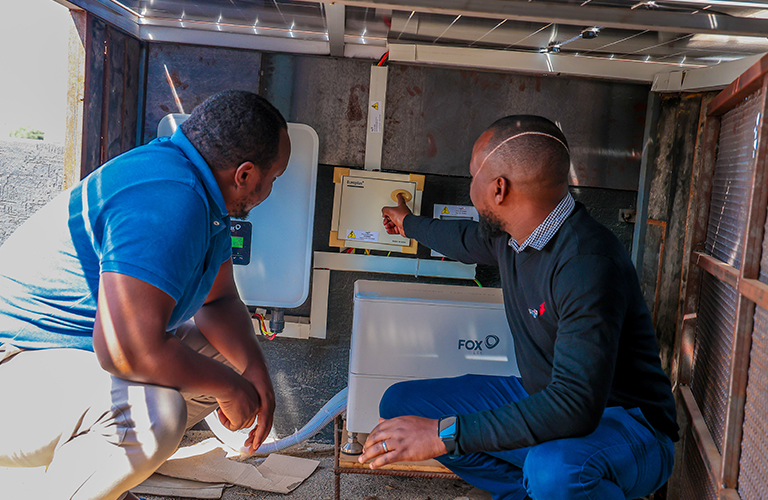
Qualified technicians should conduct a system-sizing assessment that matches a household’s electricity demand with the appropriate combination of solar panels, batteries and inverters.
An undersized system may struggle to power a home, while an oversized installation could force the owner to pay for capacity they may never use.
For David, the assessment helped him choose a system capable of meeting his family’s needs.
“The engineers visited the site, carried out their assessment and designed the system. We agreed on what was reasonable before settling on a 10-kilowatt system,” he said.
The modular installation continues to provide the household with reliable electricity.
Solar is a long-term investment
The IEA says solar equipment prices have fallen significantly over the past decade, making the technology more affordable and supporting its adoption across Kenya.
Gilbert, however, cautions homeowners against choosing equipment based on price alone. He advises consumers to engage qualified technicians, insist on proper system sizing and purchase quality equipment designed to last.
A properly designed and installed solar system can serve a household for between 20 and 25 years, making it a long-term investment rather than a quick solution to rising electricity costs.
For Hellen, the family’s experience has completely changed her perception of renewable energy.
“Solar works. I didn’t believe it. Now I’m living it,” she said.