

Government responsiveness and democratic performance, along with unmet socioeconomic needs, are important drivers of citizen engagement in Africa, a new Afrobarometer flagship report (http://apo-opa.co/407Dbzv) reveals.
Citizens are more likely to participate in political and civic activities if they are satisfied with the way their democracy works, believe that their elections are free and fair, and see their local elected officials as responsive to their needs. And contrary to theories and findings from the Global North, Africa’s least-wealthy citizens, and least-wealthy countries, report higher rates of engagement than their better-off counterparts.
The report, the second in an annual series on high-priority topics, draws on data spanning the past decade, including the latest round of nationally representative surveys in 39 countries, representing the views of more than three-fourths of the continent’s population. The analysis focuses on key indicators of citizen engagement: voting, political party affiliation, political discussion, attending community meetings, joining with others to raise an issue, contacting leaders, and protesting.
The findings, based on 53,444 face-to-face interviews, show that most Africans participate in multiple political and civic activities, with voting being the predominant form of engagement and protesting being the least common. But gaps exist, especially among youth and women. Poorer, less educated, and rural Africans tend to participate more in political and civic activities than their wealthier, more educated, and urban counterparts.
The report also shows that across 30 countries surveyed consistently over the past decade, participation levels are declining for attending community meetings, raising issues, and identifying with a political party, but they are increasing for contacting leaders.
The new flagship report is accompanied by country scorecards (http://apo-opa.co/4lIcBoD) on citizen engagement that provide an at-a-glance snapshot of the key indicators of citizen participation at the national level for each of the surveyed countries.
Afrobarometer survey
Afrobarometer is a pan-African, non-partisan survey research network that provides reliable data on African experiences and evaluations of democracy, governance, and quality of life. Nine survey rounds in up to 42 countries have been completed since 1999. Round 9 surveys (2021/2023) cover 39 countries.
Afrobarometer’s national partners conduct face-to-face interviews in the language of the respondent’s choice. National samples of 1,200-2,400 yield country-level results with margins of error of +/-2 to +/-3 percentage points at a 95% confidence level.
Key findings
The scope of political and civic participation
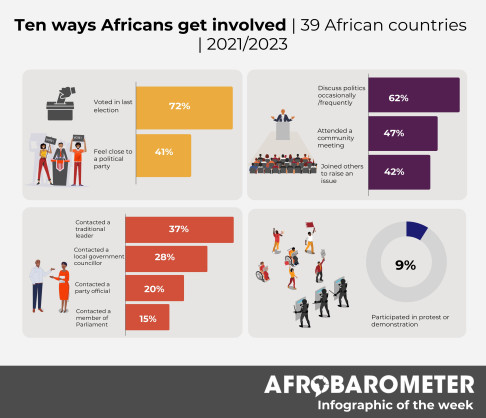
- Nearly three-quarters (72%) of Africans voted in their country’s last national election preceding the Afrobarometer Round 9 survey (Figure 1).
- Four in 10 (41%) “feel close to” a political party.
- More than six in 10 (62%) “occasionally” or “frequently” discuss politics with family or friends.
- Almost half (47%) attended a community meeting at least once during the previous year, ranging from 11% in Tunisia to 85% in Madagascar.
- More than four in 10 (42%) joined with others to raise an issue during the previous year.
- More than one-third (37%) contacted a traditional leader, 28% a local government councillor, 15% a member of Parliament (MP), and 20% a political party official during the previous year.
- About one in 10 respondents (9%) participated in a protest or demonstration during the previous year.
Who participates?
- The poorest citizens are more likely than the well-off to identify with a political party, attend a community meeting, join with others to raise an issue, and contact traditional leaders, local government councillors, and political party officials, and are about equally likely to vote, protest, discuss politics, and contact MPs (Figure 2).
- Women continue to engage at substantially lower rates than men across all indicators included in the survey.
- Youth (aged 18-35) are less engaged than older generations on all types of political and civic participation except protest; the disparity is largest for voting, where an 18-percentage-point gap separates youth from elders.
- Compared to citizens with post-secondary education, those with no formal schooling are more likely to vote, to identify with a political party, to attend community meetings, and to contact traditional leaders, and are about equally likely to contact an MP, local government councillor, or political party official.
Drivers of democratic attitudes
- Rates of participation, particularly in attending community meetings and joining with others to raise an issue, are higher in countries with lower levels of economic well-being (Figure 3).
- Countries where citizens perceive local government councillors as responsive to their needs generally have higher rates of contact with these officials. However, this pattern does not hold for national legislators, who are less accessible to ordinary citizens.
- Electoral participation is higher in countries where citizens are satisfied with the way democracy works; believe that elections are free, fair, and effective; and feel free to cast their ballots as they wish. In contrast, when these conditions are not present, protests are more common (Figure 4).
Distributed by APO Group on behalf of Afrobarometer.
For more information, please contact:
Josephine Appiah-Nyamekye Sanny
Director of Communications
Email: jappiah@afrobarometer.org
Telephone: +233 243240933
Social Media:
Facebook
X
LinkedIn
YouTube
Instagram
WhatsApp
Visit us online at www.Afrobarometer.org.
Follow our releases on #VoicesAfrica.