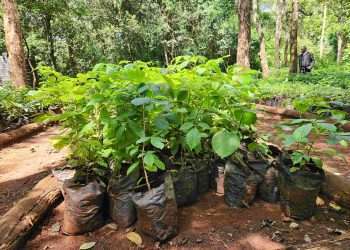
Kenya stands at the forefront with innovative community-driven reforestation initiatives, led by both the government and other local organisations. Among these, Earthtree has been weaving its ecological restoration into the fabric of rural livelihoods, especially in Kenya’s Rift Valley region.
Through partnerships with smallholder farmers, Earthtree not only enhances biodiversity and tree survival but also empowers communities to earn a dignified income without compromising land ownership. This model offers both ecological and social dividends that few interventions can rival.

One of the most striking aspects of Earthtree’s work is the diversity of tree species it promotes. Rather than focusing solely on fast-growing exotic varieties, Earthtree emphasises a mix of indigenous and multipurpose trees.
Fruit trees provide nutrition and income; nitrogen-fixing trees enrich soils, while indigenous hardwoods restore degraded landscapes and provide long-term ecological stability. This layered approach ensures that the trees support both immediate household needs and long-term environmental goals.
Tree-planting campaigns often fall into the trap of counting seedlings planted rather than tracking how many survive. Earthtree has shifted this paradigm by emphasising quality and survival rates. Farmers receive hands-on training in nursery establishment, seedling care, proper spacing, soil preparation, and integrated pest management. After planting, Earthtree conducts periodic follow-ups to monitor growth, provide extension services, and replace seedlings where necessary. This focus on quality over quantity ensures that the trees reach maturity and deliver the full spectrum of ecological and social benefits envisioned.
The ecological dividends of Earthtree’s approach are far-reaching. Increased tree cover improves watershed management, reducing soil erosion and improving water infiltration. Agroforestry systems, where trees are intercropped with food crops, create microclimates that buffer farms against heat stress and unpredictable rainfall.
Diverse tree species also attract pollinators and wildlife, reviving habitats that had been lost to deforestation. Most importantly, tree survival contributes directly to carbon sequestration, aligning Kenya with global climate mitigation commitments while providing farmers the potential to tap into carbon credit markets in the future.
Perhaps the most transformative aspect of Earthtree’s model is its respect for land ownership and farmer autonomy. Unlike some initiatives that alienate communities from their land, Earthtree’s approach ensures that farmers retain ownership of both their land and the trees. This builds trust and guarantees long-term stewardship.
The economic benefits are equally compelling. Fruit and nut trees generate additional income streams for households, while timber and fuelwood species provide future financial security. By diversifying livelihoods, Earthtree reduces rural vulnerability to climate shocks and fluctuating crop prices.
In addition, the program fosters knowledge transfer and community cohesion. Farmers share best practices, form cooperatives, and collectively negotiate better market terms for their produce. This social fabric strengthens rural communities, making them more resilient both economically and socially.
Earthtree’s partnership model with smallholder farmers offers a compelling blueprint for Kenya’s green future. By blending biodiversity restoration with farmer empowerment, the initiative demonstrates that ecological health and human prosperity are not mutually exclusive but mutually reinforcing.
The success of Earthtree lies not only in the trees that survive and thrive but also in the communities that stand taller, more empowered, and more resilient. At a time when Kenya—and the world—urgently needs scalable solutions to climate change, Earthtree’s farmer-first approach shines as a model worth replicating and supporting.
In the end, the real measure of success is not just in the millions of trees planted, but in the thriving landscapes, nourished communities, and restored balance between people and planet. Earthtree has demonstrated that when biodiversity is enhanced and farmers are empowered, sustainability transitions from being an aspiration to a lived reality.