Government is urged to invest in Information Communication Technology (ICT) and science laboratories to improve student output and performance under the new lower secondary school curriculum.


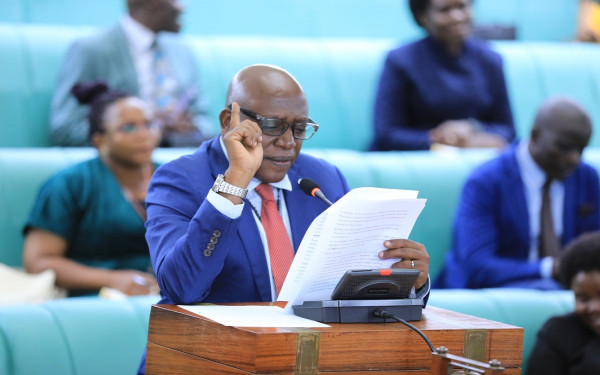
While responding to a statement by the Minister for Education and Sports on the new grading system for the new curriculum, the Shadow Minister for Education and Sports, Hon. Joseph Ssewungu said that lack of ICT infrastructure constrained the ability of schools to timely submit credit assessment scores to UNEB.
Ssewungu presented his statement to the House chaired by Speaker Anita Among on Wednesday, 26 February 2025.
Ssewungu alluded to a statement from the Uganda National Examinations Board (UNEB) Director which indicated the challenges of shortages of school laboratories.
“The new curriculum, being skills-based, requires that science labaratories and workshops are well-equipped to give the learners enough chance to create new knowledge through self-learning. Unfortunately, many rural and private schools lack these and are also short of science teachers,” Ssewungu said.
He added that the new curriculum’s emphasis on practical application raised questions about the relevance of theoretical subjects like history, C.R.E and geography to real-life problem-solving.
Ssewungu urged UNEB to improve on supervision of the assessment of the 20 per cent awarded to learners, noting that project work is not supervised, which raises questions about the credibility of the results.
Ssewungu urged government to prioritise teacher training and recruitment especially in languages like Kiswahili.
Hon. Robert Migadde (NRM, Buvuma Islands County) said schools in villages did not compete favourably in the first assessment under the new curriculum in 2024, citing lack of access to key facilities to support project work.
“Seed schools lack computer labaratories and many of them to do not have access to stable electricity, yet these are examinable courses,” said Migadde.
Speaker Anita Among, emphasised the need to improve necessary infrastructure in schools to enable project-work assignments under the new lower secondary school curriculum.
“Most of these problems are in government-aided schools. The issue of infrastructure is very crucial. It may not be under ICT or laboratories alone, but the ministry must also consider libraries,” Among said.
The Speaker tasked the Minister for Finance to provide funding for extension of electricity across the country.
“What would it cost us if we handled the Rural Electricity Authority (REA) projects that were not completed, in a similar manner like we handled roads, by giving each district Shs1 billion to finalise the electricity projects? This should be in the corrigenda for the coming budget,” Among said.
The State Minister for Finance, Planning and Economic Development (General Duties), Hon. Henry Musasizi promised to provide feedback when he presents a report on the implementation of the National Development Plan IV within the proposed budget.
Hon. Emmanuel Ongiertho (FDC, Jonathan County) made a proposal that topics on project work done by students should be based on day-to-day skills training, adding that the new curriculum should have been initiated from primary level, to enable students acclimatise easily.
Katikamu County South MP, Hon. Hassan Kirumira urged the Ministry of Education to sensitise parents on the new lower secondary school curriculum.
“Our parents are more inclined to knowing marks and how their children have performed after school which drives them away from the whole point of the new curriculum that is based on learner assessment,” said Kirumira.
Nwoya East County MP, Hon. Geofrey Okello observed that many teachers are not conversant with the curriculum’s competence based model of teaching.
“There were regional trainings for trainers of teachers however, they were never facilitated to extend the knowledge. Many teachers are not knowledgeable about what is being examined,” Okello said.
Luuka District Woman Representative, Hon. Esther Mbayo urged the Ministry of Finance to expedite the process of releasing money to facilitate the training of teachers under the new curriculum.
“A new term has started and we have many teachers who are not well versed with the new curriculum. Making the funds for training available will enable the trainers of teachers to help those supposed to implement the curriculum, to do their work well,” Mbayo said.
Hon. Stella Atyang noted that students have lost confidence in their teachers, and she stressed the need for adequate training in giving lessons under the new curriculum.
“Learners have expressed that teachers do not know what they are translating to them. Students are asked to buy textbooks but teachers are teaching and explaining different things from those expected in the curriculum,” Atyang said.
The Leader of the Opposition, Hon. Joel Ssenyonyi tasked the Ministry of Education and Sports to give continuous updates to Parliament on the progress of the new lower secondary school curriculum, and implementation of the proposed new A-Level curriculum.
The State Minister for Primary Education, Hon. Joyce Moriku appreciated proposals made by MPs adding that the reviewed curriculum produce a competitive generation
Distributed by APO Group on behalf of Parliament of the Republic of Uganda.