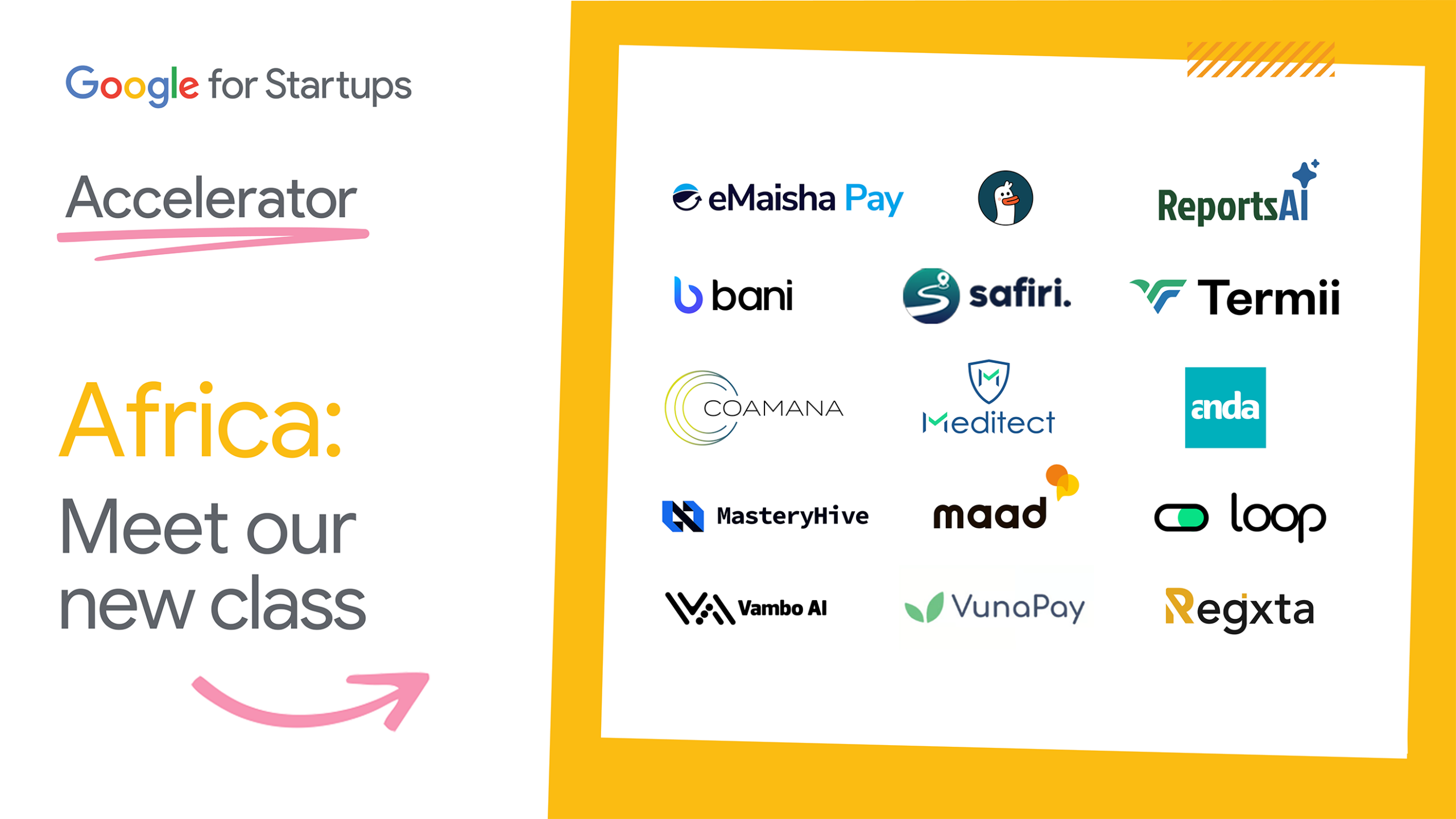
The four firms are now set to receive mentorship, technical support and AI-focused training from Google as they scale solutions targeting food markets, retail intelligence, reporting and farmer payments.
Kenya’s reputation as a technology powerhouse has received another major boost after four local startups were selected to join the 10th cohort of the Google for Startups Accelerator Africa.


The Kenyan firms — Coamana, Duck, ReportsAI and VunaPay — made it into the final list of 15 startups chosen from nearly 2,600 applications submitted across the continent.
Their selection, with an acceptance rate of less than 1%, highlights the growing strength of Kenya’s innovation ecosystem and the ability of local founders to build solutions for some of Africa’s toughest challenges.
Which Kenyan startups were selected by Google?
The four startups are using Artificial Intelligence (AI) to solve real-world problems in key sectors such as food systems, retail, reporting and agriculture.
Coamana builds technology that helps governments and market associations digitise informal food markets.
Duck runs a real-time data intelligence platform that gives consumer brands instant visibility on the shop floor, helping them prevent stockouts.
ReportsAI supports impact organisations by turning raw data into institutional knowledge and compliance-ready reporting through an AI-first platform.
VunaPay develops fintech and data infrastructure for cooperatives, enabling instant payments and wider financial services for smallholder farmers.
Why Google’s selection is significant
The inclusion of the four Kenyan startups signals how African founders are increasingly leveraging AI to tackle foundational infrastructure gaps across the continent.
From improving financial inclusion and strengthening supply chains to building smarter systems for agriculture and development reporting, many startups are now creating deep-tech products designed around local realities.
This comes at a time when Africa’s venture ecosystem is showing resilience. In 2025, the continent’s startup sector raised $3.9 billion, proving investor confidence remains strong despite global economic pressures.
However, access to funding alone is often not enough.
For many deep-tech founders, scaling requires advanced cloud tools, specialised technical support and strategic mentorship — the exact support structures accelerator programmes are designed to offer.
Coamana CEO speaks on Google accelerator opportunity
Hafsah Jumare, CEO of Kenya-based Coamana, said traditional food markets continue to play a central role in African trade despite remaining largely invisible in policy and planning systems.
“Most food trade across Africa happens in traditional markets, but these markets remain largely invisible and unsupported. With MarketView, we’re building infrastructure to make them visible, using AI to interpret real-time data so businesses and governments can actually see what’s happening and act on it,” she said.
She noted that the accelerator has already started adding value to the company’s expansion plans.
“Through the accelerator, we’re focused on scaling this across more markets and strengthening the underlying data systems and integrations that make this intelligence usable at scale. Even in the first week, the technical mentorship and network provided have already been valuable in sharpening how we approach this,” Jumare added.
Google welcomes Africa’s newest startup cohort
Folarin Aiyegbusi, Head of Startup Ecosystem, Africa, said the company was excited to welcome the new founders into the programme.
“We are absolutely thrilled to welcome these exceptional founders into Class 10. African startups are driving essential economic growth and social development. Our role is to serve as a supportive partner, providing these developers and founders with the technical infrastructure, mentorship, and global network they need to scale their solutions and amplify their real-world impact,” he said.
How long will the Google programme run?
The hybrid programme will run from April 13 to June 19, 2026.
During that period, the 15 selected startups will receive dedicated mentorship from experienced experts, as well as practical workshops focused on AI and machine learning.
The programme is expected to help founders sharpen their products, strengthen technical systems and position their businesses for long-term growth.
Google for Startups Accelerator Africa impact so far
Since its launch in 2018, the Google for Startups Accelerator Africa programme has supported 106 startups from 17 African countries.
According to programme figures, the supported startups have collectively raised more than $263 million and created over 2,800 jobs.
For Kenya, the latest selection of Coamana, Duck, ReportsAI and VunaPay adds to the country’s growing list of startups attracting global attention and backing.
Their success also reinforces Kenya’s standing as one of Africa’s leading innovation hubs, particularly in AI, fintech and digital infrastructure.