
Every year the Tabaski event involves the mass grilling of sheep, which in the capital city Niamey alone typically requires nearly 50,000 tonnes of wood – or the felling of about 25,000 trees [1]. Falling this year right after World Environment Day on 5 June, preparations for the event have contributed to Niger’s ongoing deforestation and desertification, with the country losing more than 100,000 hectares of arable land each year. The annual grilling also leads to major air pollution issues.

A group of teenagers and young adults in Niger have recruited influencers, comedians and gone online as part of a national campaign to reduce the number of felled trees burned during the Tabaski celebration, also known as Eid al-Adha.
Every year the Tabaski event involves the mass grilling of sheep, which in the capital city Niamey alone typically requires nearly 50,000 tonnes of wood – or the felling of about 25,000 trees [1]. Falling this year right after World Environment Day on 5 June, preparations for the event have contributed to Niger’s ongoing deforestation and desertification, with the country losing more than 100,000 hectares of arable land each year. The annual grilling also leads to major air pollution issues.
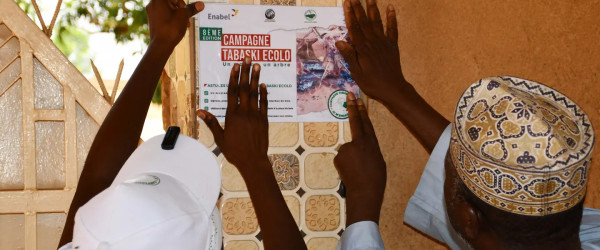
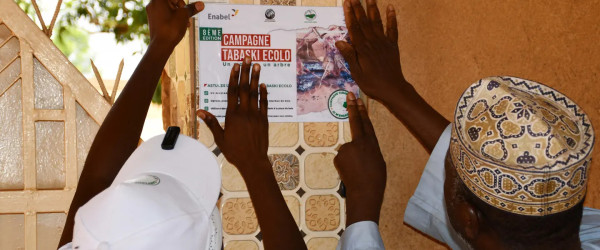
To combat this devastation, a group of young activists, supported by Save the Children, has launched the “Tabaski Ecolo” – or “Eco Eid” – campaign to promote the use of alternative energy sources to grill the celebratory food. These include the use of mineral charcoal, as well as encouraging tree planting, throughout the holiday period.
The campaign also includes awareness-raising activities of the impact of deforestation the benefits of green energy sources, and a competition for the best ecological photo.
Jafar, 17, a climate change activist who is part of the Tabaski Ecolo campaign, said:
“Sometimes people tell me that climate change isn’t a priority for them, or that it’s nobody’s business, that it’s the business of the rich countries. That surprises me, because its effects are already being felt here – extreme heat, flooding and food insecurity. The climate is everyone’s business.
“It is possible to celebrate our traditions while protecting our planet, reducing waste and taking care of our city. I like the idea of contributing to a cleaner, more sustainable world, even during key moments for us like Tabaski.”
The “Tabaski Ecolo” campaign was launched in 2017 by a national association of young volunteers for environment before Save the Children invested in the campaigners and the programme to increase its scope. In 2024, nearly 3,700 people were reached directly with different messages on the impact of climate change and pollution, and about 1,000 mango, moringa and lemon tree seedlings were distributed to communities to combat desertification.
This year, the campaign is expanding online, with the involvement of local influencers, comedians, journalists and musicians amplifying the sustainability messages.
A “caravan”, led by child activists supported by Save the Children, is also travelling door-to-door in Niamey to talk to people about how to achieve an ecological Tabaski, and inviting them to plant a tree for each sheep sacrificed.
Rahinatou, 18, who is actively involved in the “Tabaski Ecolo” campaign, said:
“During discussions with the people I met during the campaign, and even during the evaluation of the campaign, some of them told me that climate change doesn’t affect them, so they don’t worry about it, and others told me that ‘it’s God’s will’.
“But I can see that people’s behaviour is changing, and I can say that the campaign contributed to it. A lot of people are now making an effort to protect the environment. In my neighbourhood, most people grill with organic charcoal.”
Niger is one of the countries most affected by climate change. It is the largest country in West Africa, with two-thirds of the landlocked nation covered in desert and losing a significant amount of arable land each year [2]. Agriculture provides a living for 80% of the Nigerien population and contributes to 40% of the country’s GDP [3].
Save the Children’s Country Director for Niger, Oumarou Anda, said:
“Young people have a critical role to play in raising awareness about climate change, environmental issues and promoting sustainable practices. Even though they are not the cause of the problems, they are more vulnerable to the impact of the problems they know little or nothing about. With the ‘Tabaski Ecolo’ campaign, we hope to inspire a new generation of environmental leaders and promote a more sustainable future for Niger.”
Save the Children has been working in Niger since 2005 covering five regions – Maradi, Zinder, Diffa, Tillaberi, and urban Niamey – and providing interventions on child protection, health, nutrition, food security and livelihoods, education, water, and sanitation. Our priority remains the delivery of quality services adapted to vulnerable people and children who need them the most.
[1] https://www.anp.ne/niamey-pres-de-50-000-t-de-bois-partent-en-fumee-dans-les-grillades-de-tabaski/
[2] https://dicf.unepgrid.ch/niger
[3] World Bank
Distributed by APO Group on behalf of Save the Children.