Samsung Electronics Co., Ltd. has revealed its latest air filter technology that collects not only particulate matter (PM) but also decomposes volatile organic compounds (VOCs), and can be used for two decades through simple water washing. The innovative filter was detailed in a study published in the Journal Nature Communications on February 15th UK Time.
The breakthrough was born from Samsung’s desire to address the issues of frequent filter replacement due to the short cycle of six months to one year in conventional air purification systems. Additionally, such filters can only remove either PM or VOCs, thereby reducing the air purifiers’ space efficiency.


To tackle these challenges, Samsung’s researchers at the Samsung Advanced Institute of Technology (SAIT) developed and introduced an unprecedented filter technology that applies photocatalysts such as copper oxide (Cu2O) and titanium dioxide (TiO2) for the first time. The Samsung ceramic catalyst filter technology is expected to help create compact air purification systems, significantly reducing both disposable waste and the cost burden caused by frequent filter replacement.
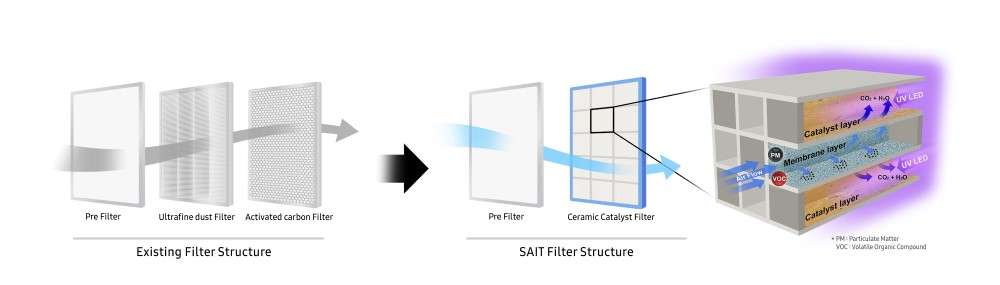
The new filter is designed to capture PMs first in the porous ceramic wall at the inlet channel, where the inorganic membrane is coated and decomposes VOC gases on the photocatalyst on the outlet channel under a single-pass airflow. It combines two different filters for dust and gas, increasing dust loading capacity by four times compared to conventional filters, from five grams per litre to 20.
What’s more, the SAIT-developed Cu2O/TiO2 photocatalyst is insoluble, making the filter regenerable through simple water-washing while still retaining its initial PM and VOC gas removal performance. Assuming ten times of regeneration through water-washing, the filter can be used for 20 years, up to 40 times the lifespan of the conventional High-Efficiency Particulate Air (HEPA) filter.
Hyuk Jae Kwon, one of the lead authors at Samsung Advanced Institute of Technology (SAIT), expressed that the project began by listening to suggestions from manufacturers and users of air purification filters. He also shared the plan to expand research to commercialise long-lifetime filters.
As a next step, Samsung Electronics plans to produce prototypes for air conditioning facilities at office buildings, bus terminals, and underground parking lots in its semiconductor campuses. The new air filter technology promises to change the air purification game, reduce waste, and minimize cost, paving the way for a more sustainable future.