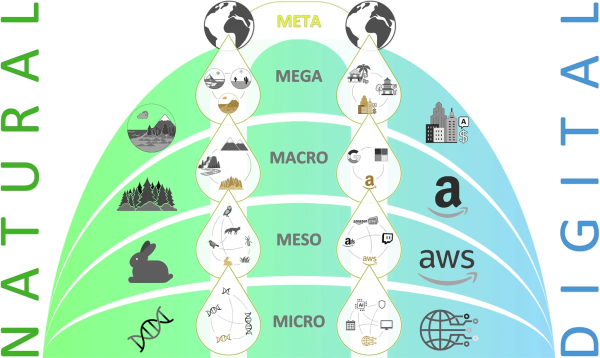

The BRICS Competition Law and Policy Centre (www.BRICSCompetition.org), in collaboration with mathematicians, programmers, ecologists and biologists from the International Institute for Applied Systems Analysis (IIASA, Vienna), has developed a systemic approach to deepen the understanding of how digital ecosystems function. The research group proposes applying mathematical models and biological theories from the natural sciences to describe processes in the digital economy. Their comprehensive approach to analysing and regulating ecosystems is built on analogies between natural and digital ecosystems—both are complex adaptive systems that share structural and functional characteristics. The results have been published in the interdisciplinary journal npj Complexity in the open-access article “An ecological perspective to master the complexities of the digital economy” (Elena Rovenskaya, Alexey Ivanov, Sarah Hathiari, Daria Kotova, Ursula M. Scharler, Gergely Boza) (www.nature.com) and in the Springer Nature Research Communities “Behind the Paper” post “Taming the Digital Giants: Why Regulators Need an Ecological Lens on Platform Power” (Elena Rovenskaya, Alexey Ivanov, Sarah Hathiari, Daria Kotova, Ursula M. Scharler, Gergely Boza) (www.communities.springernature.com).


The scientists formulated this idea as the 5M System (5M Framework), which describes the digital realm in ecological terms and draws analogies between natural and digital phenomena across five levels: Micro (“genes”) — elements of technology, knowledge, and business strategy (including user behaviour data); Meso (“species”) — products; Macro (“ecosystems”) — digital platform ecosystems; Mega (“biomes”) — wider societies hosting platform ecosystems; Meta — interactions among the four previous levels occur here.
For example, optimal foraging theory can explain why Uber avoids sparsely populated areas: like an animal that leaves a food-poor patch because the energy gained per unit of search time is too low, Uber steers clear of rural zones where ride requests are infrequent, driver utilisation drops, and the “return” on each kilometre driven fails to justify the effort. The flexibility of digital-product boundaries is akin to the blurred definition of biological species, within which finer subspecies are often distinguished: LinkedIn can be viewed either as a Microsoft service or as a set of related products—job marketplace, professional social network, advertising platform, and so on.
Elena Rovenkaya, the IIASA Advancing Systems Analysis (ASA) Program Director and Principal Research Scholar:
“Digital ecosystems are an entirely new economic object, fundamentally different from the standard economic agents regulators are used to dealing with. The analogy we propose between natural and digital ecosystems will allow antitrust authorities to look at digital ecosystems from a new angle and obtain intuitive explanations for business strategies that often seem complex. Moreover, applying well-established mathematical and ecological approaches may be more effective than designing new methods from scratch.”
Aleksey Ivanov, Director of the BRICS Competition Law and Policy Centre:
“The published article is expected to be the first in a series of interdisciplinary publications devoted to new antitrust approaches for regulating the digital environment. In the AI sector and adjacent fields, the number of partnerships and investment agreements resembling mergers is growing, yet companies often evade antitrust scrutiny by sidestepping formal filing thresholds. A systemic-analysis response—particularly mathematical modelling and the systems-mapping method that the BRICS Centre is developing with partners—can depict a complex phenomenon in a model of all its cause-and-effect links. This will significantly accelerate research and make antitrust analysis more precise.”
In the future, the researchers also plan to create a digital tool using AI for BRICS antitrust coordination — the “Merger Radar.” This system will detect economic-concentration deals and shape preliminary positions on such transactions.
The article forms part of the BRICS Centre’s research track on the antitrust challenges created by digitalisation. The project was launched in 2018 to provide expert and methodological support to antitrust agencies in the BRICS Working Group for Research on Competition Issues in Digital Markets; in 2019 the Centre first highlighted the threats posed by digital platforms and the need for special oversight; from 2020 the Working Group shifted its focus to ecosystem regulation — today the most advanced debate in antitrust law. At the 7th BRICS Competition Conference (China, 2021) the Centre publicly presented the “eco-antitrust” concept; in 2022, in Brazil, it organised the first BRICS Digital Competition Forum, which has since been held annually. At the latest forum, in autumn 2024, representatives of Brazil’s antitrust authority CADE announced the drafting of a new bill to regulate ecosystems, which is now before the Brazilian parliament. The experts are currently analysing the impact of AI on competition and preparing a new report.
Distributed by APO Group on behalf of BRICS Competition Law and Policy Centre.