“I still see the knife, and the lady who held me down,” said Hawa’a Mohamed Kamil. Now 30, she was subjected to female genital mutilation at just six years old – an experience that left not only physical but also psychological scars.

“I’m afraid of men, of everyone, of everything,” she told UNFPA, the United Nations sexual and reproductive health agency. Female genital mutilation is internationally recognized as a human rights violation, and involves altering or injuring the female genitalia for non-medical reasons. Over 230 million girls and women worldwide are survivors of the practice, and an estimated 27 million more are at risk of being subjected to it in the next five years.
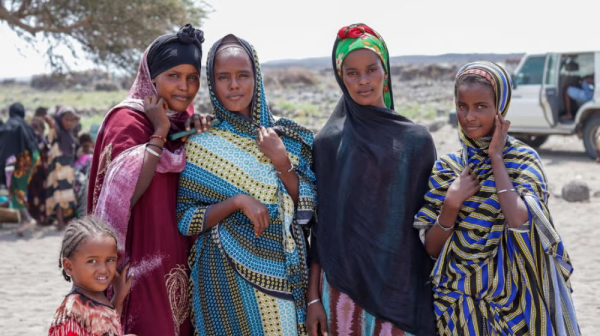
Hawa’a made a choice to channel her fear and anger into becoming an advocate with the UNFPA-supported ‘Elle&Elles’ network, which lobbies for sexual and reproductive health and rights in Djibouti. Together they travel from Djibouti City to remote villages to raise awareness, including among boys, who can play a crucial role in shifting societal attitudes.
She even persuaded her own family members to adopt her message – simple yet revolutionary for such a traditional area: Abandon female genital mutilation.
Breaking the cycle
In the northern-central Tadjourah region, 39-year-old Khadija crosses miles of unforgiving terrain to encourage families to spare their daughters from the procedure. After the UNFPA-UNICEF Joint Programme on the Elimination of Female Genital Mutilation visited her village of Otoy with an awareness-raising session, she decided to join the cause. “Twenty five years ago, I let my daughter go through female genital mutilation,” she told UNFPA. “But I have vowed to protect my granddaughter.”
A survivor herself, Khadija had seen the pain that follows female genital mutilation, as well as the infections, complications during childbirth, and even tragic deaths. “We lost many women who bled to death before they could reach a health facility,” she said.
She began weaving her message of change into conversations first with women, then men, and even religious leaders. But their journey was far from smooth, as both women described being ostracized by their communities and chastized for spreading ‘false information.’ “People suspected my motives,” recalled Khadija. “They couldn’t believe I was doing this for free, from my heart.”
Yet their commitment remains unshaken. “I am proud of the change we see today,” said Hawa’a. For Khadija, the transformation has been remarkable: Her village recently made a public declaration to abandon the practice for good. “Change takes time, but it comes eventually,” she said.
A lesson in resistance
At a nearby school, the classroom buzzes with young voices reciting French phrases in unison. Beyond the lessons in grammar and vocabulary, however, 31-year-old Ibrahim is teaching something more profound – the value of girls’ rights and well-being.
“I made a vow that if I got married and had baby girls, I wouldn’t subject them to this and make them suffer.” He brings awareness of female genital mutilation’s harms into his lessons, gently guiding his young students towards a future where girls are empowered and their health safeguarded.
But when his first daughter was born, Ibrahim had to choose between upholding his promise and confronting opposition from his family, including his wife and grandmother. He chose to keep his promise.
“The most important thing is health,” he said. “I urge all families to take care of their girls’ health and to not cut them.” His stand against female genital mutilation has rippled through his community, where over 100 people now oppose the practice.
A woman of faith leading the charge
Hawi Mohammed, 46, is a mother of five, a community activist and a respected religious leader. She’s also a prominent member of the Shamikhat Djibouti network – a regional religious leaders’ group against female genital mutilation – and a survivor herself.
As a child she was subjected to what is often referred to as infibulation, in which part or all of a girl’s external genitalia are removed and the opening sealed over. An agonizing and dangerous procedure, it can lead to severe bleeding, infections and all too often death. Hawi said she only understood the full extent of the violation when she hit puberty: The pain, especially during menstruation, was excruciating. “I couldn’t go to school. I needed painkiller injections just to function.”
Her fury fuelled her advocacy, and she now hosts a popular radio and television programme in the Afari language, delivers lectures in mosques that challenge traditional interpretations and emphasize the true spirit of Islam, and travels to remote corners of the country to spread awareness.
“People used to run away when we talked about female genital mutilation,” said Hawi. “But the new generation is different. Mothers are educated, informed. They are doctors, activists, and teachers.”
Hawi’s own daughters and nieces are living proof of her commitment: Despite facing pressure from family and community members, she refused to subject them to female genital mutilation. “I’ve gone through enough pain – I won’t let any girl suffer like I did.”
Distributed by APO Group on behalf of United Nations Population Fund (UNFPA).