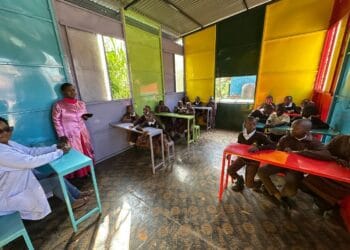
In a major step toward faster and more localized outbreak response, Africa CDC convened public health leaders from ten African countries in Yaoundé to co-develop a continental framework for decentralizing laboratory services. The four-day workshop, which began on 14 July, placed equitable access to diagnostics at the core of Africa’s epidemic preparedness and response strategy.


Organized by the Africa Centres for Disease Control and Prevention (Africa CDC), in partnership with the Ministry of Health of Cameroon, the World Health Organization (WHO), and the European Union, the workshop brought together government officials, national laboratory directors, and public health experts from across the continent. Together, they produced the Continental Guidance for the Decentralization of Laboratory Services—a practical, action-oriented tool to help Member States design national diagnostic strategies that bring testing closer to communities and improve outbreak detection and response.
“Member States cannot respond effectively to outbreaks if diagnostic capacity is limited to national reference laboratories. Detection capabilities must be decentralized to sub-national levels and below to enhance early warning surveillance and timely confirmation of disease threats,” said Dr. Yenew Kebede Tebeje, Acting Director, Centre for Laboratory Diagnostics and Systems, Africa CDC. “Decentralized laboratory services are also essential for achieving Universal Health Coverage.”
Dr. Kakambi Christelle, a senior official from Cameroon’s Ministry of Public Health, shared the country’s approach to decentralizing diagnostics for epidemic-prone diseases. This includes strengthening regional laboratories, training personnel, establishing a national sample transport system, and conducting lab mapping to improve surveillance.
“Laboratory detection is the first line of defense in identifying potential outbreaks. Decentralizing labs widens the net, increasing our chances of catching the culprit pathogen early and guiding timely public health action,” said Rachel Achilla, WHO AFRO representative.
Delegations from Burundi and the Democratic Republic of Congo (DRC) demonstrated how Mpox diagnostic capacity was expanded from just two laboratories to 56 in Burundi and 27 in DRC—within a single year—dramatically improving detection and case management.
“One of the key lessons learned from recent epidemics in Africa is the strategic value of decentralizing diagnostics to overcome sample transport delays and accelerate response,” noted Professor Pembe Issamou Mayengue, researcher at the National Public Health Laboratory, Brazzaville, Republic of the Congo.
However, participants acknowledged that decentralization is not without challenges. While it brings diagnostics closer to communities, it also multiplies the burden on fragile health systems—particularly where data integration, trained personnel, equipment maintenance, supply chain management, electricity, and internet access remain unresolved.
“National Public Health Laboratories serve as the backbone of laboratory services decentralization by setting standards, guiding policy, ensuring quality, and mentoring peripheral laboratories. Their leadership is critical to building a resilient, responsive system,” emphasized Gifty Boateng, a public health researcher and academic from Ghana.
Over four days, participants co-developed a practical, adaptive guideline rooted in African realities and global good practices. The document offers strategic orientations to help countries implement decentralization in ways that ensure ownership, institutional integration, and sustainability.
“If we move from two laboratories with chronic issues in sample collection, data flow, infrastructure weakness, and supply chain bottlenecks, decentralizing laboratories means multiplying these challenges in proportion to the expansion,” warned Yao Selom, Unit Lead for Laboratory Systems and Networks at Africa CDC. “Our presence here is essential to guide, alert, and support Member States in identifying what to consider, how to prepare, and how to move forward.”
This initiative is part of the Partnership to Accelerate Mpox and Other Outbreaks Testing and Sequencing in Africa (PAMTA) program, launched by Africa CDC and ASLM, and co-funded by the European Union through the Health Emergency Preparedness and Response Authority (HERA), and administered by the European Health and Digital Executive Agency (HaDEA). It contributes to a broader continental effort to strengthen diagnostics, build technical capacity, and improve readiness for epidemic threats across Africa.
Together, we can detect faster, respond smarter, and save lives!
Distributed by APO Group on behalf of Africa Centres for Disease Control and Prevention (Africa CDC).