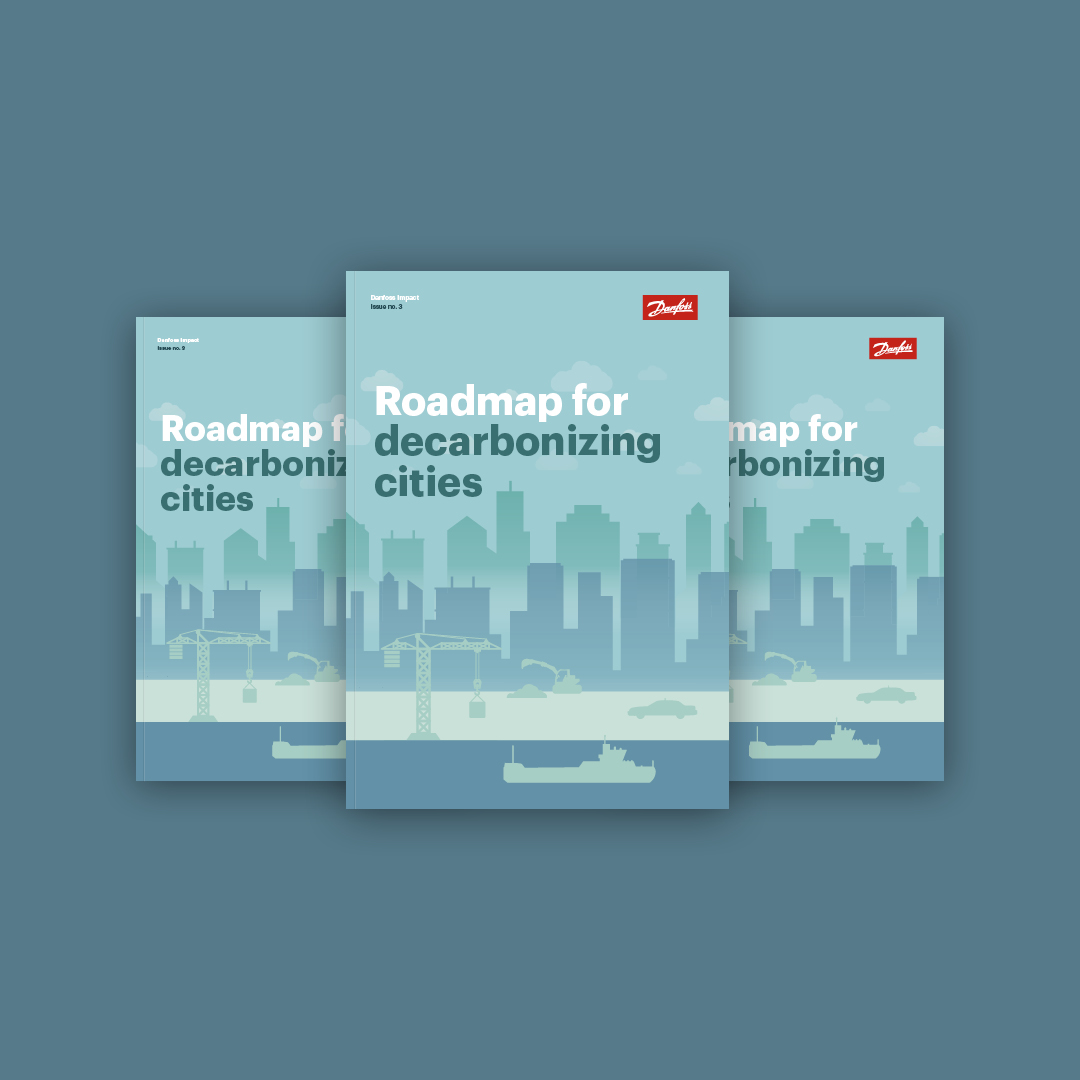
New whitepaper from Danfoss lays out new roadmap for decarbonising cities. Implementation of existing technology for buildings, transport, and sector integration can bridge half the gap in the urban GHG emissions reductions needed for a 1.5°C pathway.
Cities account for 70% of global carbon emissions. Ultimately, the battle against climate change will be won – or lost – in cities.


Action is needed urgently to make the changes necessary to enable large-scale decarbonisation. To address this challenge directly, Danfoss is releasing a new whitepaper which sets out a clear, achievable pathway forward to enabling a green transition on a large scale. The paper shows how existing energy efficiency and electrification measures across sectors can immediately reduce emissions and accelerate a green transition in cities.
Commenting on the launch of the whitepaper, Kim Fausing, President and CEO, Danfoss, said: “We will not reach the goals of the Paris Agreement without a deep decarbonisation of cities. The good news is that cities offer some of the best possibilities to optimise urban planning and accelerate a green transition, and there are already accessible, cost-efficient technologies out there capable of cutting emissions sufficiently to meet global climate goals. These technologies are already in use every day – for instance in the city of Sønderborg in Southern Denmark (Project Zero) – but they must be adopted more widely on a global scale now.”
As the world’s population continues its surge towards 10 billion people by 2050[1], it is now expected that almost 70% of the world’s inhabitants will be city dwellers by this date. In their current form, with energy demand continuing to grow, cities would produce a wholly unsustainable level of emissions that would be completely incompatible with key climate targets, such as the 1.5°C target set out by the 2015 Paris Agreement.
“Deep decarbonisation of cities is crucial for achieving key climate targets globally. As cities account for a significant portion of carbon emissions, our battle against climate change will be won or lost within these urban centres. Danfoss has ready solutions to facilitate large-scale decarbonisation in Africa, but urgent action is needed. To address this challenge head-on, Danfoss is proud to release a new whitepaper that presents a clear and achievable roadmap for enabling a green transition at a significant scale. This whitepaper highlights how existing energy efficiency and electrification technologies can immediately reduce emissions and accelerate the transition to a sustainable future across the continent,” added Emil Berning, Country Manager – Danfoss Sub-Saharan Africa.
The whitepaper, ‘Roadmap for decarbonizing cities’, draws upon a diverse range of verified sources, including the latest data from the International Energy Agency (IEA), to demonstrate why action is needed. The whitepaper also shows how that action can be taken, and highlights how the solutions that will enable this are already available.
Key takeaways:
· Energy efficiency in cities is essential for global decarbonisation. If all urban areas and cities in Europe, the US, and China invested in energy-efficient heating and cooling of buildings, this would contribute 20% to the 1.5°C target of the Paris Agreement.
· Electrification of vehicles will play a large role. Electrification of urban transport, both private (light) and public (heavy), is crucial for successful climate targets. 28% of the decarbonisation necessary to stay within the 1.5°C target of the Paris Agreement would be achieved if all urban areas in Europe, the US, and China electrified private and public transport.
· Improved efficiency can accelerate the electrification of transport. Both in passenger cars, heavy duty vehicles, and in marine transport, efficiency measures can reduce the size of the batteries needed thus limiting the raw material requirements. Increasing efficiency can also bring down the demand for charging infrastructure and increase the productivity and range of the vehicle.
· Implementation of existing technology for buildings, transport, and sector integration can bridge half the gap in the urban GHG emissions reductions needed for a 1.5°C pathway.
The whitepaper analysis provides a concrete roadmap for mayors, local decisionmakers, and urban planners on how to eliminate all major drivers of the carbon footprint of cities. The paper also explores how available technologies can improve the livelihoods of citizens while at the same time making our economies more resilient and creating jobs. Ultimately, it offers a holistic and concrete view of the major opportunities for decarbonising cities.