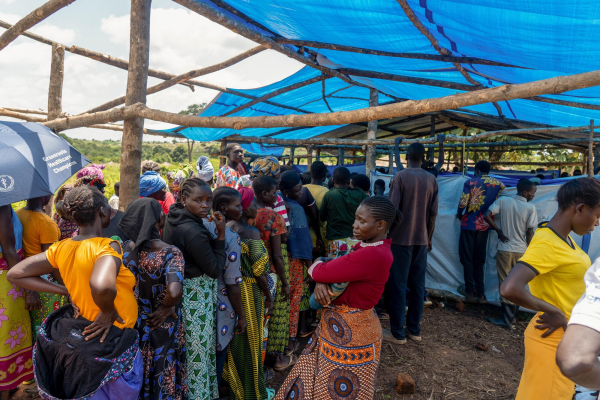
With violence intensifying in South Sudan, more than 33,000 refugees have fled to northern Democratic Republic of Congo (DRC). In May, Médecins Sans Frontières (MSF) teams launched emergency activities to provide lifesaving medical care to a community facing crisis.

“We saw people shooting guns. Then we saw planes shooting people from the sky,” says Blessing Halima, a refugee from Morobo County, South Sudan, who recently fled to Adi, northern DRC, with her six children. “They began killing people and stealing everything. They took my husband. That’s why we ran.”
Blessing Halima is not alone. In April, Atay Rose travelled for several days through the bush to reach Adi from Panyume, South Sudan.
“If we used the main road, we would have been killed. They rape young girls and even married women,” says Atay. “I don’t know if I can go back. There’s still looting. There’s still raping. There’s still the killing of women and children. That’s what we fear the most.”
South Sudan is experiencing its most severe surge in violence since the signing of the peace agreement and end of its civil war in 2018. The crisis escalated in February, when clashes broke out between government forces and armed youths, known as the White Army, in the northeastern state of Upper Nile.
The violence quickly spread to other parts of the country, incorporating armed groups in Central Equatoria state, which borders DRC to the south. There have been widespread civilian casualties throughout the country – with more than 730 civilians killed between January and March alone. [1]
Between January and June, an estimated 300,000 people were displaced by the violence according to the UN,[2] of whom 125,000 fled to neighbouring countries, including Sudan, Ethiopia, Uganda, and DRC. In DRC, more than 33,000 people have arrived since April, according to the country’s National Council of Refugees.
Instability has led to the total collapse of already-fragile public services, and MSF has been forced to close two hospitals and scale down operations in the country amid attacks on health facilities.
Most people arriving in DRC have fled Morobo county in Central Equatoria state, which has become highly volatile due to intensified fighting this year. A few days ago, we were forced to suspend all activities in Morobo—including services in camps for internally displaced people—as well as in neighbouring Yei River county. This decision followed the abduction of health workers, including one of our own staff members.
Arriving with nothing
Ituri province, in northeastern DRC, where most of the South Sudanese crossing into the country arrive, has itself been beset by conflict for decades, characterised by violence, ethnic division and a wide prevalence of armed groups. Even prior to the arrival of South Sudanese refugees, health systems were under strain and almost non-existent in the border area.
Many refugees arrive with few or no possessions whatsoever, having hastily fled South Sudan for their lives.
“We are suffering,” says Jacob Justin, who travelled alone with nothing but the clothes on his back. “We have no schools, no hospitals and no access to clean water.”
Viola Kani fled across the border in May with her brother and four children.
“We ran away with nothing. They took our food and clothes,” she says. “Now we are dying of hunger and don’t have anything to sleep on.”
Six percent of children aged 6 to 59 months seen by MSF teams near the border are suffering from severe malnutrition, which represents a major public health problem, according to Dr Léonard Wabingwa, MSF’s medical activity manager in Adi.
MSF response
To address the growing needs of the refugees, MSF launched an emergency response in May. We sent two mobile clinics and set up six community healthcare centres.
In less than two months since activities were launched, more than 3,000 medical consultations were carried out—with the weekly average of more 370 consultations continuing to rise. Malaria accounts for more than half of all cases, followed by respiratory tract infections and acute gastroenteritis. We screen children under five years old for malnutrition, treating patients with therapeutic food.
“We have also provided care to several survivors of sexual violence, including some as young as 12,” says Dr Wabingwa.
Risk of disease outbreaks
Measles cases have already been reported among the refugee community, and an MSF-supported mass vaccination campaign, targeting 62,000 children, is set to begin in August to reduce the risks of an outbreak. A parallel vaccination campaign will seek to provide routine vaccinations to a further 520 infants and 310 pregnant women.
“Instability in South Sudan means routine vaccinations have been interrupted,” says Félicien Lwiteo, MSF project coordinator in Adi. “If you are running for your life, it is difficult to respect a medical appointment. There’s a real risk of disease outbreaks and it’s vital that we act quickly.”
MSF is also working on critical infrastructure projects. Our teams are installing six water distribution points and 200 latrines and showers, expected to be completed by mid-August. Additionally, nearly 6,000 non-food item kits containing essential items—such as mosquito nets, buckets, soap, and portable toilets—will be distributed to families.
Mounting needs, limited support
With more refugees arriving daily in DRC, MSF’s capacity to meet the growing needs is under pressure.
“There are very few international organisations on the ground and none that are providing the same range of medical services as MSF,” says Asiyat Magomedova, MSF Head of Programmes covering the area. “Without support from other partners, there is a risk that further lives will be lost.”
In South Sudan, the situation remains “critical” according to Dr Ferdinand Atte, MSF Head of Mission in the country.
“It is crucial to ensure safe and unobstructed access to populations in need, and to protect civilians and civilian infrastructure, including medical facilities, before we can consider resuming our activities,” says Dr Atte. “While we are deeply committed to providing care to those in need, we cannot keep our staff working in an unsafe environment.”
For the South Sudanese refugees now living in DRC, there is little hope of returning home anytime soon.
“If we go back, that means we are going to die,” says Viola. “How can we go back there?”
[1] UNMISS: Violence against civilians surges amidst escalating conflict in South Sudan (January – March 2025) | UNMISS
[2] OCHA – South Sudan: Humanitarian Snapshot (June 2025) | OCHA
Distributed by APO Group on behalf of Médecins sans frontières (MSF).