African-led science and innovation are at the heart of efforts to transform agrifood systems across the continent. That was the central message of a dedicated side event held during the Regional Policy Dialogue on Strengthening South-South and Triangular Cooperation (SSTC) in Africa, organized by the Food and Agriculture Organization of the United Nations (FAO) and hosted by the Government of the United Republic of Tanzania.


The special side event, Scaling Science and Innovation for Resilient Agrifood Systems: African Solutions through South-South and Triangular Cooperation, took place on the second day of the Dialogue and comes in the lead-up to the Science and Innovation Forum during the FAO World Food Forum in October. It brought together African experts, researchers, and policymakers to explore how homegrown innovations can drive agrifood systems transformation across the continent.
Opening the session, FAO Assistant Director-General and Regional Representative for Africa Abebe Haile-Gabriel underlined the power of science and innovation in transforming agrifood systems in Africa. He urged countries to scale up successful practices through strengthened partnerships and better policy alignment.
“Africa stands today at a defining moment. Our agrifood systems face immense pressure from intensifying climate change, growing scarcity of land and water, frequent pest and disease outbreaks, and persistent post-harvest losses that undermine productivity and incomes. Yet, amidst these challenges, a new generation of African scientists, entrepreneurs, and innovators is reimagining agriculture, its business model, mechanisms of knowledge sharing, and scaling up technologies,” he said.
In the keynote address, Professor Anthony Egeru of the Regional Universities Forum for Capacity Building in Agriculture (RUFORUM) highlighted Africa’s untapped potential in homegrown scientific knowledge and innovation. He called for stronger collaboration among African research institutions, noting that intra-African cooperation in science remains limited and must be strengthened to support agrifood system transformation and reduce the continent’s growing food import bill.
Two expert panels followed. The first highlighted scalable technologies already benefiting smallholder farmers. The second explored how science-policy partnerships can create enabling environments for innovation uptake.
Among the innovation champions featured was Innovative Solutions for Decision Agriculture (ISDA), a pan-African company pioneering digital agricultural tools. Their flagship product, the Virtual Agronomist, is a WhatsApp-based AI chatbot that provides farmers with instant, tailored advice on soil health and fertiliser use. The company has already seen a 60 percent yield increase among farmers who use the tool, and their goal is to reach 10 million farmers over the next five years with this context-specific, science-backed guidance.
FAO also showcased its innovation in plant protection through the eLocust3, a real-time data transmission tool used by national locust officers to monitor and control desert locust outbreaks. The tool feeds directly into FAO’s global Desert Locust Information Service, which supports early warning and coordinated response systems across affected countries.
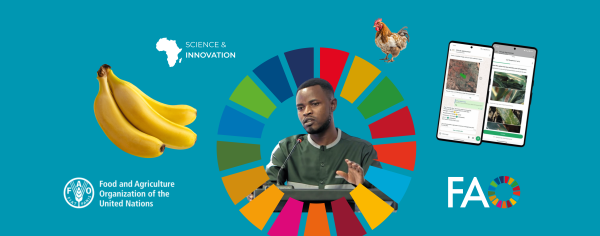
Young innovator Joseph Kawaya from Rwanda (pictured) also presented his work. Initially focused on manufacturing solar-adapted chicken incubators, his business now supports rural cooperatives through a franchised network of hatching stations. “We’re not just selling machines, we’re building rural systems that tackle both malnutrition and lack of access to poultry production,” he said.
FAO South-South Cooperation Officer Peter Anaadumba underscored the importance of enabling environments to support innovation. He stressed that innovators must be supported by strong policy frameworks, sustained financial commitments, and partnerships. South-South and Triangular cooperation, he noted, offers a platform for exchange, but results will only follow when national systems are ready to absorb and scale innovation.
The event reinforced FAO’s commitment to advancing African-led solutions and fostering cross-country learning, setting the stage for deeper engagement at the upcoming Science and Innovation Forum later this year. Science and innovation are central themes in the FAO Strategic Framework 2022–2031, which aims to support countries in transforming agrifood systems to be more efficient, inclusive, resilient, and sustainable.
Distributed by APO Group on behalf of Food and Agriculture Organization of the United Nations (FAO): Regional Office for Africa.