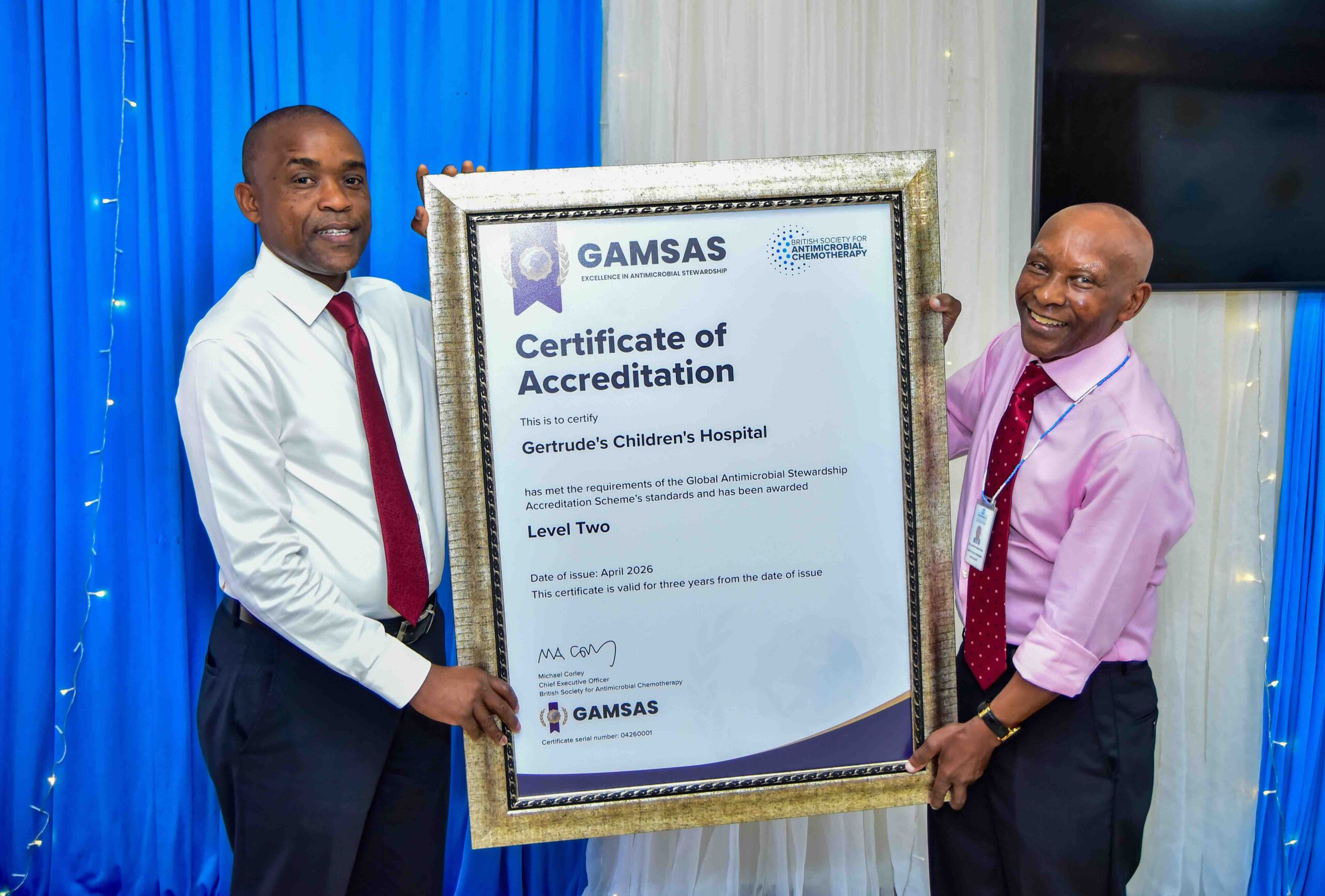
Gertrude’s Children’s Hospital is calling on Kenya’s healthcare stakeholders to strengthen their response to antimicrobial resistance after becoming the first institution in the country to receive a globally recognised accreditation for promoting antimicrobial stewardship.
The hospital has received the prestigious Global Antimicrobial Stewardship Accreditation (GAMSAS) for effective antimicrobial stewardship by the British Society for Antimicrobial Stewardship (BSAC).


The accreditation places the hospital among a select group of healthcare institutions worldwide that meet the highest standards in antimicrobial stewardship, ensuring responsible use of antibiotics to protect patients and preserve the effectiveness of life-saving medicines for future generations.
Dr. Robert Nyarango, CEO of Gertrude’s Children’s Hospital, noted that the accreditation is an indication of the hospital’s commitment to improving clinical outcomes and support Kenya’s national action plan on antimicrobial resistance.
“We are proud to be the first organisation in Kenya to achieve BSAC GAMSAS accreditation. It is a commitment to every patient who walks through our doors that we will use antibiotic medications responsibly, especially as antimicrobial resistance continues to threaten public health outcomes. We are grateful to the BSAC and all partners who made this accreditation possible, especially Pfizer who provided a grant award to facilitate BSAC support. We urge other players in the industry, including patients, to stop overuse of antibiotics which contributes to antimicrobial resistance,” said Dr. Nyarango.
Antimicrobial resistance occurs when bacteria, viruses, and fungi evolve to resist the drugs designed to treat them. A 2022 publication by The Lancet noted that AMR was directly responsible for 1.27 million deaths globally and associated with 4.95 million deaths in 2019, making it a major public health threat. The Institute for Health Metrics and Evaluation estimates that 28,500 deaths in Kenya were associated with AMR. Left unchecked, experts warn that AMR could reverse decades of medical progress, making common infections increasingly difficult to treat.
Dr. Joseph Mbuthia, a paediatric infectious disease consultant and Chairman of the Gertrude’s Children’s Hospital Antimicrobial Stewardship Committee, said, “AMR is growing public health concern in Kenya, posing a serious threat to human, animal and environmental health. The achievement underscores the critical role healthcare institutions play in addressing antimicrobial resistance.”
In 2019, the Gertrude’s Children’s Hospital Antimicrobial Stewardship Committee established a restricted list comprising selected World Health Organisation (WHO) Watch antibiotics, all WHO Reserve antibiotics, as well as certain antivirals and antifungals. Use of these agents beyond a defined empiric period requires microbiological justification or approval by an infectious disease specialist.
During the quality improvement period, average compliance scores increased from 66% in 2020 to 94% in 2025, reflecting a 42% improvement, surpassing the original project target of 80%. In addition to this, standard treatment guidelines compliance increased from 50% in 2022 to 86% in 2025, representing a remarkable 72% relative improvement.
Crucially, this milestone aligns with the ambitions of the Kenya National Action Plan on Prevention and Containment of Antimicrobial Resistance which provides a comprehensive roadmap for tackling AMR through improved awareness, strengthened surveillance, infection prevention, and optimised use of antimicrobial medicines.