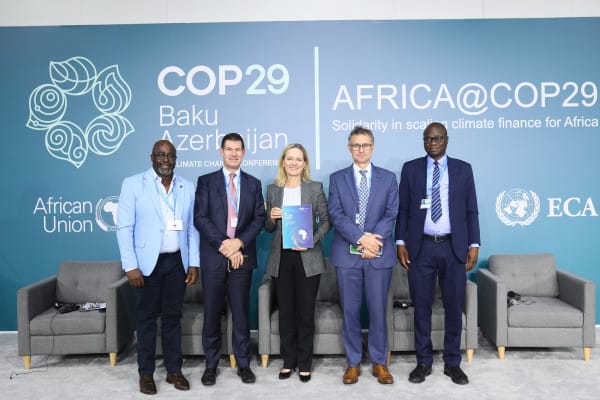
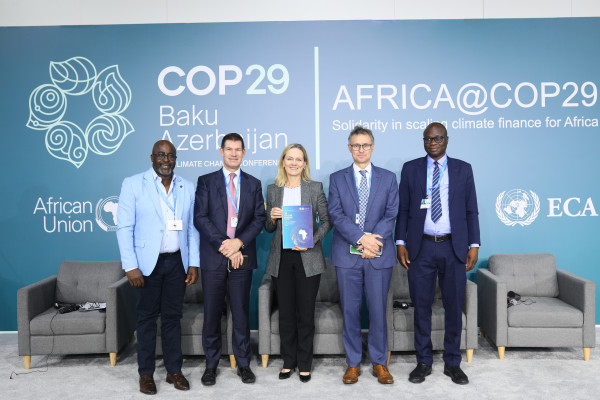
The World Bank Group, the World Wide Fund for Nature (WWF) and other stakeholders have hailed the African Development Bank’s (www.AfDB.org) Ten-Year Strategy (2024-2033) (https://apo-opa.co/3V5zk38), adopted last May, as an essential and comprehensive tool for combating climate change and protecting biodiversity.


These viewpoints were expressed at a round-table discussion on “Africa’s Green and Inclusive Future: Climate and Biodiversity Solutions in the African Development Bank’s Ten-Year Strategy”, held on Thursday at the United Nations Climate Change Conference (COP 29) in Baku, Azerbaijan.
According to Caroline Kende-Robb, Senior Director of Strategy and Operational Policies at the African Development Bank, the new Ten-Year Strategy, the vision of which is to build a “prosperous, inclusive, resilient and integrated Africa”, includes climate resilience and biodiversity as one of its five cross-cutting pillars.
“The Ten-Year Strategy builds on the Bank’s Climate Change and Green Growth Strategic Framework Operationalising Africa’s Voice Action Plan 2021-2025” (https://apo-opa.co/410ul7U) explained Kende-Robb, who moderated the discussions. “It aims to harness climate finance at sufficient scale and speed through resources, partnerships and commitments to advance green economy value chains. This will be achieved by ensuring that Africa’s potential in renewable energy, smart agriculture, sustainable transport, waste management, water management, carbon trading and other climate-smart sectors is fulfilled.”
Durrel Halleson, Policy and Partnerships Manager for Africa at the WWF, added: “I’d like to pay tribute to the African Development Bank’s new Ten-Year Strategy 2024-2033. Unlike its predecessor, this one seems more comprehensive to me. For the first time, it takes biodiversity into account, which appears six times in the document. This shows the progress made by the Bank. The WWF has been working with the Bank since 2010, and we have launched initiatives related to agriculture, energy and power that align with the Bank’s ‘High 5s’.”
The High 5s are the Bank’s core operational priorities, identified as pillars in the new strategy.
Congratulating the African Development Bank on getting the adaptation and mitigation financing part right, Robin Mearns, Global Director for Social Development at the World Bank Group, said:
“The new strategy provides a framework for addressing Africa’s current and future challenges. It provides a favourable context for creating the conditions for investment in Africa […] The strategy sets out the challenges well.” He went on to point out that the cross-cutting elements of the strategy (youth, reducing gender gaps, strengthening governance, etc.) were also in keeping with the World Bank’s actions.
The African Development Bank’s Ten-Year Strategy, based on the priorities of African countries, highlights the critical need to raise climate finance, including from the private sector, to invest in natural capital and to strengthen partnerships to address the growing impact of climate change and biodiversity loss – hence the need for expanded partnerships with multilateral development banks.
African Development Bank as example of adaptation financing
Africa will need $2.7 billion between now and 2030 for its climate action. Yet the continent receives barely three per cent of this funding, despite the fact that it is steadily increasing.
As far as Al-Hamndou Dorsouma – Acting Director of the Climate Change and Green Growth Department – is concerned, countries’ capacity to access climate finance needs to be increased. The Bank already has various financing instruments, some of them via partnerships, the latest being the Climate Action Window for the 37 lowest-income African countries.
Between 2021 and 2023, the Bank raised $1.3 billion in global climate finance and, in cooperation with the Global Center on Adaptation (GCA), launched a $25 billion programme to accelerate and scale climate adaptation.
The African Development Bank is the only multilateral development bank to have achieved funding parity for climate adaptation and mitigation. Over the past three years, 60 percent of the Bank’s climate financing has been devoted to adaptation, and the Bank now boasts an ambitious biodiversity programme. The institution is also working to ensure that natural resources are included in the calculation of African countries’ GDP.
All participants agreed that it was vital to position people and communities at the heart of all climate action, as only 17 per cent of climate funds actually reach local communities.
“We need to make certain that funding is shared between national authorities and local communities, implement participatory methods and ensure that local operations are based on scientific information and endogenous knowledge in order to plan climate actions effectively,” underscored Mearns.
Gareth Phillips, Head of the Climate and Environment Finance Division at the African Development Bank, stressed that the institution wanted to channel climate funds in a comprehensive manner. He added that the New Collective Quantified Target (NCQG), currently being negotiated in Baku, was important for the Bank in order to specify who would contribute and how much.
“We multilateral development banks want to channel these funds as effectively as possible so as to offer more financing to our member states,” he said, adding that the Bank had between $40 and $44 million available for adaptation programmes.
“Non-market-based instruments are a good way of channelling climate funds, as they are more efficient – some adaptation projects would not receive funding if we stuck to market-based financing mechanisms,” he continued, expressing regret about the fact that developed countries contribute very little to adaptation efforts. “They need to assume their responsibilities.”
“It is essential to set targets to facilitate Africa’s access to climate financing,” concluded Al-Hamndou Dorsouma.
Distributed by APO Group on behalf of African Development Bank Group (AfDB).