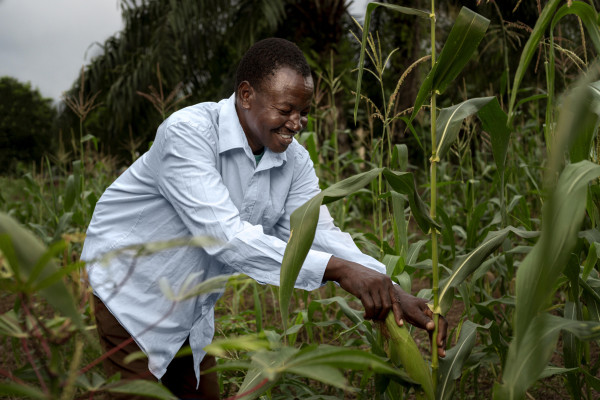

In the early morning, the fields stretch as far as the eye can see, bathed in the soft light of the rising sun. In Kwilu, Kasai, and Tshopo provinces of the Democratic Republic of the Congo (DRC), rural communities are reclaiming their land with renewed energy. Here, every furrow in the earth tells a story of resilience and hope.

These fertile lands have long been trapped in a vicious circle of poor-quality seed, limited access to fertilizers, outdated farming techniques, low yields, and unstable incomes. A tradition of subsistence farming has confined families to day-to-day survival, leaving them vulnerable to climate shocks and food crises.
That has changed thanks to the deployment of the Emergency Food Production Project (https://apo-opa.co/3TDmJmU) (PURPA in the French acronym), which is being implemented by the African Development Bank (www.AfDB.org) as part of the African Emergency Food Production Facility (https://apo-opa.co/4kAFbr2). The project aims to restore food production in the most vulnerable rural areas of the DRC as rapidly as possible.
Large-scale distribution of seeds and other agricultural inputs lies at the heart of the project and has delivered a decisive impact:
- More than 325 tonnes of rice, 388 tonnes of maize and 1.4 million linear metres of cassava cuttings have been distributed, far exceeding initial forecasts.
- 49,749 farming households have been reached, primarily women, who are often on the front line in the battle to feed their families.
Villagers in the communities covered by the project are enthusiastic, reflecting a rebirth of hope as the fields come back to life. The seed is in the ground and local people believe the harvest should be sufficient to meet their families’ needs while leaving a surplus for sale on the market.
Beyond the distributions, PURPA has strengthened the capacities of agricultural research stations such as the one at Kiyaka in Kwilu province in the centre of the country, enabling local production of improved maize and rice seeds. Over 100 tonnes of maize seed, 33 tonnes of rice and 2.55 million cassava cuttings have been produced. The distribution of 334 tonnes of fertilizer also offers a guarantee of suitable and affordable seeds for future seasons.
Targeted training programmes have also been launched. The Project financed the training of 300 managers and administrative staff, 30% of whom were women, using the “farmers’ field-school” approach with a focus on seed production and technical itineraries. These initiatives not only improve yields but also strengthen the capacities of women and agricultural cooperatives.
A final push to distribute fertilizer and seed produced by the research centres is scheduled for the coming months. Multiple outcomes are expected: increased farm incomes through the sale of surpluses; the creation of new economic opportunities, particularly for women and young people; significant improvement in food security with a reduction of lean periods; and the development of more autonomous agriculture that is less dependent on external aid.
Local authorities in several provinces are also observing a reduction in rural exodus as young people return to their towns to participate in this new-style agriculture, attracted by more promising prospects.
For these communities, the Emergency Food Production Project is not just a response to the global food crisis. It is a veritable “school of resilience” where solidarity, local know-how and agricultural innovation support and encourage each other.
In these regions of the Democratic Republic of the Congo, farming is no longer just about survival. In these newly seeded fields, it has become a means of development, investment, and heritage. Much remains to be done, but the transformation is underway. In these once fragile rural lands, a conviction is taking root: change, from now on, comes from here.
Distributed by APO Group on behalf of African Development Bank Group (AfDB).