At the recently concluded United Nations General Assembly in New York, one overarching theme that emerged during the conversations was youth empowerment and how we can translate development commitments into opportunities for growth.
For a country like Kenya whose employment challenge is closely tied to the ability of young people to find productive and sustainable livelihoods, the issue of skills development must therefore go beyond access to education and training to ensuring that young people acquire practical, market-relevant competencies that enable them to participate meaningfully in the economy.

According to the Kenya National Bureau of Statistics, Kenya had 21.6 million people in recorded employment in 2025, with 87.2 per cent of those jobs in the informal sector. Behind these figures are millions of people building livelihoods through small businesses, trades, agriculture and other forms of self-employment.
This is where the work of KCB Foundation becomes significant, given its approach to providing training with an end goal of translating into the ability to earn and build.
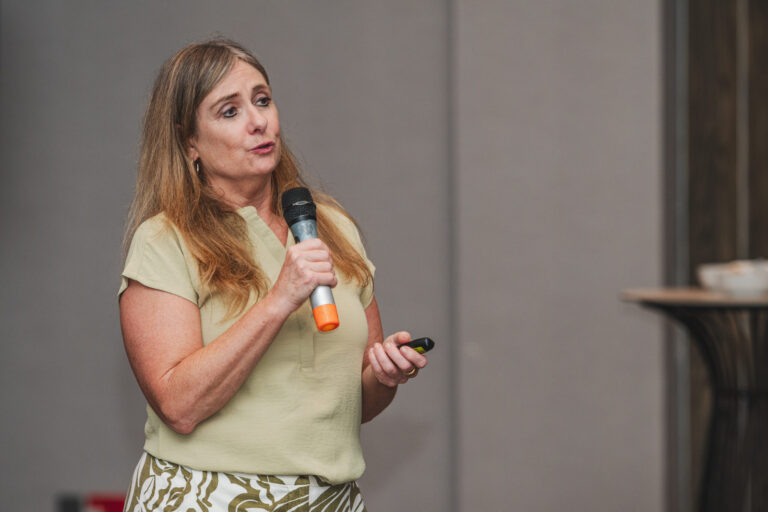
Speaking at the United Nations Global Compact Leaders Summit, KCB Foundation Managing Director Mendi Njonjo said: “The lesson for us is that impact must be designed around the realities people face every day. Skills, finance, markets and partnerships must come together if we are to create pathways that enable young people and communities to build sustainable livelihoods.”
Patricia Musangi’s journey illustrates what this looks like in practice. As an entrepreneur specializing in interior and exterior works, fittings, metalwork, welding, and fabrication, she started her training in Automation Engineering at Proteq Automation in 2018, where she was awarded a scholarship by KCB Foundation under the 2Jiajiri program.
After the completion of phase one of the program, Patricia got onboarded onto the Business Development Services side and was assisted to register her company under the name of Joann’s Interior and Exteriors Limited and set up her business in Machakos County.
Since incorporation, Joann’s Interior and Exteriors Limited has undertaken and completed more than 200 projects, all various construction projects, in different Counties in the country. She has employed two full-time employees and 45 young people on a contract basis since incorporation. What began as an opportunity to acquire technical skills has since evolved into a pathway towards entrepreneurship, demonstrating how access to skills and support can help young people turn training into a livelihood.
Her success is proof that KCB Foundation programmes now enable young people to pay
their bills from a business they built, entrepreneurs who can employ additional workers, farmers whose income becomes more predictable, or students whose educational journey is no longer interrupted by the inability to pay school fees.
Similarly, this was a key thread running through KCB’s engagements at UNGA 2026, including discussions with UNICEF’s Generation Unlimited Global Leadership Council, Axum conversation on the childcare economy, bilateral meetings, roundtables and side meetings on the global public-private-youth partnerships focused on expanding opportunities for young people.
KCB Group CEO Paul Russo noted that the ambition is to take existing interventions further across the region. “We want to scale the existing initiatives, even as we seek new avenues to deliver meaningful impact and dignity for jobless youth across East Africa. We have the footprint and understanding of the markets on our side to better anchor such programmes,” noted Russo.
As curtains closed on this year’s forum, the emphasis on scale is important given that Kenya’s employment challenge cannot be addressed through isolated interventions. A global commitment becomes meaningful when it translates into a young person earning an income, an entrepreneur expanding a business, a farmer accessing a better market, or a student staying in school.